PAGE 8 –– AUGUST 2012 THE GROWER
WHAT’S YOUR STORY?
Blueberry harvester boasts efficiency edge KAREN DAVIDSON There’s no school that teaches efficiency, unless it’s the real-life classroom of Elwood Lawton. This self-motivated, self-taught farmer is usually found in his Stratford, Prince Edward Island machinery fabricating shop. That’s where he’s modified “graveyard” equipment into the most efficient harvester possible for wild blueberries. In August, his larger-than-life tinkerings will be brought to bear on the Maine blueberry crop before moving to custom harvest in New Brunswick and finally to the home stretch on his own 1,800 contiguous acres in Prince Edward Island. Of that acreage, he has 700 in blueberries. The results are in the statistics: 450 pounds of wild blueberries in 45 seconds. Wild blueberries are difficult to harvest on land that’s not naturally flat or free from trees and stumps. To harvest successfully, the machine must be flexible enough to scoop the berries a half-inch from the ground. Until recently, the most efficient operator has had two picking heads, whereas Lawton has five picking heads on his harvester. But as Lawton explains, the drive is always for more efficiency to compete against cheaper imports. “My competition is not other blueberries,” says Lawton. “It’s cherries and plums from Chile -all the other fruits that go into desserts.” Several years ago, he scouted for used grain combines and disassembled one that he found in St. Mary’s Ontario. All he wanted was the cab, wheels, engine and hydrostatics. The parts worked so well that he later
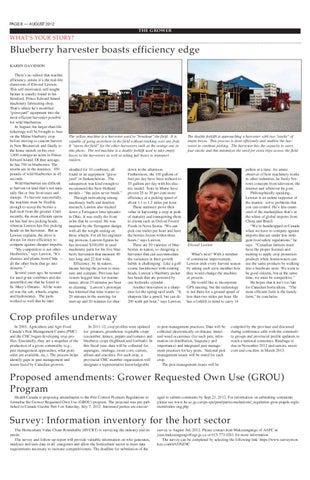
The yellow machine is a harvester used to "breakout" the field. It is capable of going anywhere in the field without tracking over any fruit. It "opens the field" for the other harvesters such as the orange one in this photo. The red machine is a double forklift used to take empty boxes to the harvesters as well as taking full boxes to transport trailers. sleuthed for 10 combines, all found in an equipment “graveyard” in Saskatchewan. The salesperson was kind enough to recommend the New Holland models – “the axles never break.” Through networking among machinery buffs and Internet research, Lawton also tracked down a Terragator lime spreader in Ohio. It was really the front axles that he coveted. He was inspired by the Terragator design, with all the weight resting on three wheels. For all his engineering prowess, Lawton figures he has invested $100,000 in used machinery parts for his five blueberry harvesters that measure 40 feet long and 22 feet wide. Efficiency, by its nature, means having the power to measure and compare. Previous harvesters hogged time for maintenance, about 20 minutes per hour in cleaning. Lawton’s prototype has trimmed that time-waster to 20 minutes in the morning for start-up and 20 minutes for shut-
down in the afternoon. Furthermore, the 100 gallons of fuel per day have been reduced to 55 gallons per day with his electric model. Tests in Maine have proven 25 to 30 per cent more efficiency at a picking speed of about 1.1 to 1.2 miles per hour. These statistics prove their value in harvesting a crop at peak of maturity and transporting them to clients such as Oxford Frozen Foods in Nova Scotia. “We can pick one trailer per hour and have the berries frozen within three hours,” says Lawton. There are 50 varieties of blueberries in nature, so designing a harvester that can accommodate the variances in their growth habits is challenging. Like a golfcourse lawnmower with rotating heads, Lawton’s blueberry picker has heads that are powered by one hydraulic cylinder. Another innovation is a sharpener for the spring steel teeth. “It sharpens like a pencil, but can do 200 teeth per hour,” says Lawton.
The double forklift is approaching a harvester with two "stacks" of empty boxes. This process is done efficiently and enables the harvester to continue picking. The harvester has the capacity to carry four stacks and this minimizes the need for extra trips across the field.
Elwood Lawton What’s next? With a mindset of continuous improvement, Lawton ends every harvest season by asking each crew member how they would change the machine or process. He would like to incorporate GPS steering, but the technology is not there for a ground speed of less than two miles per hour. He has a forklift in mind to carry 14
pallets at a time. An astute observer of how machinery works in other industries, he freely borrows concepts from television, the internet and wherever he goes. Philosophically speaking, Lawton is an ardent supporter of the mantra: solve problems that you can control. He’s less enamored of the marketplace that’s at the whim of global imports from China and Brazil. “We’re handicapped in Canada when we have to compete against imports that are under less stringent food safety regulations,” he says. “Canadian farmers must have the proper licenses and training to apply crop protection products while homeowners can use the same products by walking into a hardware store. We want to be good citizens, but at the same time, we must be competitive.” He hopes that it isn’t too late for Canadian horticulture. “The most efficient farm is the family farm,” he concludes.
Crop profiles underway In 2003, Agriculture and Agri-Food Canada’s Pest Management Centre (PMC) and the CHC began developing crop profiles. Essentially, they are a snapshot of the production of a given commodity (e.g., pest management approaches, what pesticides are available, etc.). The process helps identify gaps in pest management and issues faced by Canadian growers.
In 2011-12, crop profiles were updated for: potatoes, greenhouse vegetable crops (cucumber, lettuce, pepper and tomato) and blueberry crops (highbush and lowbush). In this fiscal year, data will be collected for asparagus, rutabaga, sweet corn, carrots, allium and crucifers. For each crop, a provincial CHC member organization will designate a representative knowledgeable
in pest management practices. Data will be collected electronically on disease, insect and weed occurrence (for each pest, information on distribution, frequency and importance) and integrated pest management practices for key pests. National pest management issues will be noted for each crop. The pest management issues will be
compiled by the province and discussed during conference calls with the commodity groups and provincial profile updaters to reach a national consensus. Rutabaga is due in November 2012 and carrots, sweet corn and crucifers in March 2013.
Proposed amendments: Grower Requested Own Use (GROU) Program Health Canada is proposing amendments to the Pest Control Products Regulations to formalise the Grower Requested Own Use (GROU) program. The proposal was pre-published in Canada Gazette Part I on Saturday, July 7, 2012. Interested parties are encour-
aged to submit comments by Sept 21, 2012. For information on submitting comments please see www.hc-sc.gc.ca/cps-spc/pest/part/consultations/_regulation-grou-piapda-reglement/index-eng.php
Survey: Information inventory for the hort sector The Horticulture Value Chain Roundtable (HVCRT) is surveying the industry and its needs. The survey and follow-up report will provide valuable information on who generates, analyzes and uses data in all categories and allow the horticulture sector to meet data requirements necessary to increase competitiveness. The deadline for submission of the
survey is August 3rd, 2012. Please contact Jean Mukezangango of AAFC at jean.mukezangango@agr.gc.ca or 613-773-0261 for more information. The survey can be completed by selecting the following link: https://www.surveymonkey.com/s/6336ZNC