

Family Recipe Nguyen’s cooking reaches ‘Next Level’ See Page 2 Dallas College Eastfield Campus Wednesday, March 8, 2023 Volume 54, Issue 6 Etera Eastfield loses to Richland in district semifinals. See Page 9

The kitchen is a warzone. Onions and poblanos are chopped to bits in the machine gun-like chatter of a silver knife as thick steam rises from a bubbling, crimson stew. Preston Nguyen pivots to a stove, breaking an egg into a pan over a steady flame.
In a fast-paced kitchen, the 19-year-old chef can’t stay in one place too long. He plates the egg once it crisps into a sunny-side up, placing it next to an assortment of colorful spices.
“You build muscle memory,” Nguyen said, pinching cilantro and salt without measurement, then seasoning the egg in precise sprinkles. “That’s what it’s supposed to look like … and then also you develop what it’s supposed to taste like.”
Nguyen is making chilaquiles, the same dish he served Gordon Ramsay on the second episode of “Next Level Chef,” but this time he’s serving the dish in his Arlington home.

Nguyen’s cooking is taking him to new levels in a cutthroat industry. Although he hasn’t yet graduated from Dallas College, he’s traveling the world seeking career opportunities. He looks forward to making his first cooking demo this summer in London.


“I like the challenge,” Nguyen said. “It adds this level of excitement, not knowing what the outcome is going to be.”

The El Centro student started pursuing his culinary journey at Dallas College in Fall 2021. He’s currently taking a gap year to focus on competition, followed by relaxation away from the kitchen.
After that, he wants to become the youngest recipient of the James Beard Award, a medal presented for outstanding culinary achievement.
Nguyen got his big break in the 2021 World Food Championships. Competing in the World Chef category, he battled 1,500 veteran chefs, many of whom had been in the craft longer than he’d been alive.
“Going into it, I was intimidated because I’ve seen these people on TV before and I grew up watching them,”
Nguyen said.
With his parents as sous chefs, they served numerous dishes while steamrolling through the tournament brackets, culminating with fried quail lollipops in a hot honey
glaze. It made Nguyen the youngest winner in the category’s history –earning him a $100,000 prize.
Now the Nguyens are creating a family business. And hopefully, opening a restaurant in the coming
When word came out about Nguyen’s victory at the World Food Championships, he returned to his El Centro culinary class to a round of applause.
“Preston was amazing. [He] really struck me as a student who worked with deep commitment and focus,” culinary instructor Jeffrey Glick said. “[He] had a lot of attributes I looked for when I was in the industry and interviewing applicants.”
Glick is no stranger to teaching successful chefs in his 30-year career, but Preston went the farthest by reaching the limelight of national television.
“I take pride in that,” Glick said. “I was thrilled to have a student reach that level so early in his career.”
The cheers weren’t confined to the classroom. Tarrant County officials marked Oct. 25 as Preston Nguyen Day in honor of the chef’s victory.
“I’m thankful for how supportive everyone is because that’s another thing that keeps you going,” Nguyen said.
Nguyen started his culinary journey at age 7. His first dish was a scrambled eggs breakfast-in-bed for his aunt.
“She liked it a lot,” Nguyen said. “It felt nice to be able to serve somebody else.”
Cooking runs on both sides of Nguyen’s bloodline. All four of his grandparents were chefs, who then passed their skills on to Nguyen’s parents. When his parents noticed the young chef’s interest in cooking, they taught him how to work the kitchen. Nguyen quickly caught on and began cooking dinners for his family. He even became one of the main chefs for Thanksgiving dinner.
“[My family has] always been here for me, and so giving back to them always has a special place in my heart,” he said.
years.
“This is something we can achieve together as a family,” Nguyen said. “[We can] take culinary competitions to the next level and change the food scene.”
Cooking was just a hobby throughout middle school and most of high school. His primary focus was the architecture program at the University of Texas at Arlington.
“I got really far in the program in high school,” Nguyen said. “Then, in


See NGUYEN, page 12

Isabel Wilkerson compares America to an old house. If you live in an old house you know that the work is never done. One day you might replace the refrigerator, but then two days later the toilet won’t flush. It requires constant work and vigilance to make improvements.
After a rainstorm the basement might flood, but not going into the basement doesn’t mean the problem isn’t there. It’s lurking beneath, waiting to be dealt with.
Wilkerson uses metaphors like this in her book “Caste: The Origins of Our Discontents” to help readers understand that racism hasn’t left the U.S.
The first African American to win a Pulitzer Prize for individual reporting, Wilkerson spoke about the issues Black Americans face every day at a virtual meet and greet hosted by Brookhaven on March 1, followed by a panel discussion with Dallas College faculty and administration.

“The first step is acknowledging that we do have a caste system in higher education, right?” said panelist Dominica McCarthy, associate dean of student success at Brookhaven. “Creating those safe spaces to have those honest conversations and helping people understand that it’s not about blame. It’s about stating what the reality is and then figuring out ways to get an understanding of each other and how we can come up with solutions together.”
“Caste” was chosen as Dallas College’s most recent common book. The program is meant to give readers on all seven campuses a common thread that transcends the different academic disciplanaries, ages, genders and races that otherwise might separate them.
“One of the things that we can do as educators is to be willing to talk about the topic,” English faculty Cheri Edwards said. “Talking about race in our classes is difficult. It’s difficult for students. I’m at Cedar Valley, and I find that a lot of my students have never talked about it … So, being willing to have the conversation in small increments where they are allowed the chance to ingest some of the things before we move on to the next part is important.”
“Caste” focuses on the idea that there is still a caste system in America, even if it is not actively supported or understood by most. Americans
are pitted against each other to maintain a higher status in society only to benefit the very few at the top.
“For so many people, there’s this feeling of, ‘I might not have it all, but at least I’m not at the bottom.’ And that’s the message of the caste system,” Wilkerson said.
During the question-and-answer portion of the meet and greet, Wilkerson was asked if there was a parallel between the caste system metaphor in her book and the mudsill theory coined by former U.S. Sen. James Hammond from South Carolina.
Hammond said that every society must find a class of people assigned to do the menial labor, and assigning this class based on race was the natural way to go. In other words, they are the mudsill, or the framing structure, on which the rest of society is built upon. This theory was used as an argument to support slavery.
Wilkerson acknowledged the similarities between her caste system metaphor and Hammond’s mudsill theory. The difference, however, is her desire to destroy these ideas, while Hammond hoped to strengthen them.

“It takes a tremendous amount of effort to keep people down,” Wilkerson said. “And while you’re holding someone down, you’re not allowing yourself to rise in ways that we cannot imagine, and to transcend these divisions within our species.”
Conversations about racism, hate crimes, dehumanization and other stressing topics can be difficult to talk about when the same experiences aren’t shared by all.
Incorporating “Caste” into his curriculum has forced English faculty Timothy Cedor to find new ways
to help students contribute to the conversation. Instead of waiting for a raised hand, he has students turn in discussion topics ahead of time and reads them anonymously so conversation can flow easily without fear or judgment.
“That allows them to get their voice into the conversation as well,” Cedor said. “And it’s one of the few times I actually sit down in the class. Now I’m not the expert in the room anymore. I’m somebody who needs to learn from the experts in the room.”
Wilkerson said she understands that much of the racism and issues today weren’t created by the current generation. However, pretending it doesn’t exist won’t help.
“Look deeply into history to make sure that it’s not repeated,” Wilkerson said. “That’s one of the things that I think is necessary to be able to push past this. To somehow transcend and overcome it. You cannot heal from what you have not diagnosed, you cannot fix what you haven’t named, and you cannot repair what you cannot identify.”
A member of Dallas College tested positive for tuberculosis, prompting a health warning from the Dallas County Health and Human Services Department.
“Although the risk of becoming sick with TB is very low, DCHHS and the college are doing everything to ensure that the necessary measures and precautions are taken,” Sharon Davis, chief business continuity officer, wrote in an email to employees on March 2.
The DCHHS is working with Dallas College to identify and assist those who may be at risk for contracting TB, which can be spread through the coughs of an infected person. Additionally, it can only be spread through prolonged contact with an individual, and not through surfaces or consumables.
Dallas College Chancellor Justin Lonon revealed in his “60 Minutes With” video released Dec. 19, that the administration is seeking to replace its current accreditor, the Southern Association of Colleges and Schools Commission on Colleges.
“I think we owe it to ourselves as Dallas College, as a new institution, to see ‘do we have an accreditor that is meeting the rate of change and the progress and innovation that we want to focus on?’” Lonon said.
Accreditors assess the quality of academics, which can affect which courses, degrees and scholarships are offered. Although switching accreditors has no bearing on an employee’s “day to day role,” Lonon pledges that the administration is carefully considering options.
A House Republican has authored a bill to ban polling places on college campuses. House Bill 2390 would bar polling places on college campuses due to “safety concerns,” according to State Rep. Carrie Isaac, the bill’s author. Voting rights advocates argue that the bill would suppress young voters.
“We must do everything we can to make our school campuses as safe as possible; they should not serve as a target-rich environment for those that wish to harm children,” Isaac said in a statement supporting the bill. The representative also pledged to pass a bill that would ban polling places in K-12 institutions. HB2390 is currently awaiting movement in the legislative chambers.
Gov. Greg. Abbot has set his sights on diversity, equity and inclusion hiring practices in the 88th legislative session.
While the Texas Legislature has yet to vote any initiatives into law, the GOP and Abbott are setting the stage for limitations on diversity, such as a ban on diversity, equity and inclusion policies in state-funded agencies, including higher education institutions.
“When a state agency adjusts its employment practices based on factors other than merit, it is not following the law,” Gardner Pate, Abbott’s chief of staff, wrote to Porter Wilson, executive director of the Employee Retirement System. “Rebranding this employment discrimination as ‘DEI’ does not make the practice any less illegal.”
Institutions such as the University of Texas system and University of Texas A&M system have rolled back their DEI hiring practices in response to the memo’s remarks.
When Alex Lyda was asked about the future of Dallas College’s DEI office, replied with no comment.
The Et Cetera also sent four emails to DEI Senior Director Jasmine Parker for comment, but has received no reply.
"Removing DEI initiatives will only hurt our TX economy. … We urge Gov. Abbott to
reevaluate his position & instead, join us in promoting the advancement of all Texans," Democratic Rep. Victoria Neave Criado said in a tweet from the Mexican American Legislative Caucus Twitter account.
Neave Criado’s district includes parts of Mesquite, Garland and Dallas.
Dallas College is a majority-Hispanic institution, serving a student population that is 37% Hispanic, 25% Black, 25% white and 8% Asian.
Abbott said that DEI-based hiring is illegal by extension of anti-discrimination laws. By se-
lecting candidates to promote diversity in the workplace, it’s counterintuitive to diversity, said Abbott.
Diversity in hiring practices date back to former President Lyndon B. Johnson, rooted in anti-discrimination laws in the 1960s. Laws such as the Equal Pay Act of 1963 set the stage for diversity-based hiring practices. However, Texas Republicans have targeted diversity initiatives for years.

Last year, state Rep. Carl Tepper, R-Lubbock, filed a bill prohibiting state funding toward
“any office of diversity, equity, and inclusion,” or an office that supports DEI goals.
And in 2021, Abbott signed into law a bill that banned students in high school and below from participating on school sports teams that did not align with their gender assigned at birth.
Recently, Abbott, alongside 77 House Republicans, expressed his support for a bill that would expand the ban to higher education.
Dallas College supports LGBTQ students through its Office of Inclusive Excellence. In the past, the college has hosted an LGBTQ student summit and drag queen bingo on campuses. The college is "committed to creating a campus culture which celebrates diversity and empowers students to realize the full potential of their authentic selves,” according to the Office of Inclusive Excellence website.
While the administration has provided no comment, it continues to voice support for diversity at Dallas College on its web pages for inclusivity.
Meanwhile, groups like the National Association for the Advancement of Colored People have spoken against the governor’s initiatives.
“The governor's initiative will do enormous harm and take the state backwards,” NAACP president Gary Bledsoe said in a Feb. 14 news conference.
The current legislative session ends May 29, and several outlines have been drafted to prioritize bills before it wraps up.
Aaron Yah loves reading books about his home country, Liberia. But it’s not enough – Yah wants to learn about what’s beyond his homeland’s borders.
“There’s always a lesson. The more you learn of people, the more you’re experienced in understanding,” Yah said.
After meeting economics instructor Willie Kim Kamara, a West African immigrant, Yah pitched forming an African Student Union at Eastfield.
They both set out on a recruitment effort starting Spring 2023.
“I’m working on making more friends with Africans. An African student club is going to get more Africans together,” Yah said.
Yah was promptly selected as the club president for his initiative, said Kamara, who serves as the organization’s adviser.
However, recruitment has slowed.
There were students who signed up in Fall 2022, but the majority went their separate ways after winter break.
“For the last several months, we’ve been trying to get it off the ground,” Yah said.
Communication and scheduling issues have also prevented the club’s leadership from pinpointing a date
for their first meeting.
“It’s a struggle getting the students to do something,” Kamara said. “It’s a new thing. They have never had this kind of exposure and I’m trying to introduce it to them.”
Several of the students who have expressed interest come from African countries such as Nigeria, Rwan-
da and Eritrea.
Even faculty have voiced support for the organization: anthropology instructor Selam Hailemariam, an Eritrean immigrant, said her support was inspired by participating in cultural student unions during her college days.
“You’ve got these amazing students at Dallas College, and they can bring their experience and share it with other Dallas College students,” Hailemariam said.
African student organizations were established at other Dallas College campuses, such as Richland and El Centro.
“I’ve seen it at Cedar Valley, I’ve seen it at North Lake, I’ve seen it at Richland, and it’s not just African students,” Hailemariam said.
Kamara founded an African Student Union at North Lake. Although it didn’t take off due to a lack of members, there remained momentum for students like Yah to pick up the pieces.
“I told [Kamara] that it was the best idea to establish one here as well.
We have many African [students] here,” Yah said.
Difficulties in scheduling and interest continue to hold them back, but Kamara hasn’t lost focus with the goal to promote African culture.
“Many people misunderstand looking at Africa,” Kamara said. “It’s a big continent, and there’s different cultures. Therefore, we need to know each other and learn their culture.”
During the Feb. 8 club fair, one of numerous events where the African Student Union tried to interest students, Yah and Kamara decorated the table with a taste of their home continent.

Sitting on an exotic cloth, a colored assortment of handmade trinkets, charms and other accessories rested on the stand. All of the items have origins from different countries.
“I never heard about [other countries], especially their culture,” Yah said. “If we come together and explain…what we do in Kenya, what we do in Liberia, what we do in Nigeria, we’re invited to know more about [Africa].”
 By MATTHEAU FAUGHT Presentation Editor @TheEtCetera
There’s a lot of discussion among educators, marketers, journalists and writers on how their worlds will be impacted by AI content creation tools. ChatGPT is one such tool that’s been growing in popularity. Users enter a prompt and, much like how AI art programs like Midjourney and Stable Diffusion produce a relevant image, ChatGPT provides text. This text can range from a sentence or two to a work spanning the length of a novel.
Social media is awash with various accounts of students using ChatGPT to cheat on their coursework. From students writing short answers to entire essays, educators are concerned about how they’ll be able to cope with the increasingly popular technology.
“I was very worried, until I tried it,” said Andrew Tolle, an Eastfield English instructor. “There is no way this would ever be able to replace human work.”
Tolle has students write analyses on various works, including poems, plays and novels. As a demonstration to the class, he issued a poem as a prompt to ChatGPT and asked it to write an analysis.
“They could see it has some interesting thoughts. If that had been submitted, it wouldn’t have even got a 50,” Tolle said.
The reason ChatGPT would not get a passing grade is because it is prone to slipups. Tolle noted how the program misidentified a character in a short story as a third-person protagonist multiple times. While it may struggle with long-form analysis and essay writing, the Chatbot might be effective at small-scale assignments. This raises the question of whether students will use these tools as a shortcut, reducing their student engagement with coursework.
“When you decide you’re no longer going to think critically to write a paper and to synthesize ideas and to analyze ideas, your ability to do it will become lost,” said Tuesday Hambric, a psychology and learning framework instructor at Eastfield.
Hambric argued that this technology in its current form could hinder student learning because they aren’t arriving at the answer through prob-
lem solving.
instructor adapts the technology and engages students.
teaching them how to use it and helps them understand the impli cations of using it in a negative way, I think it could help them,” Hambric said.
“Technology is just going to happen.
It’s already here. So it’s one of those things where instead of scream ing bloody murder, we’ve got to ask ourselves, ‘how can we embrace this technology to better help students?’”

tools is helping students understand difficult concepts.
cess to certain conventions of writing that may not be accessible to folks immediately,” Tolle said.
The writing styles may be academic or professional. It may also aid students who speak English as a second language and struggle to write it.
“I see artificial intelligence as a great equalizer,” marketing insturctor Wade Hyde said. “Those folks who might’ve had at-risk students, English was not their primary language, the enormous jump from not only having to learn English but then learning the nuances of writing skills, it takes time. AI will help accelerate that process,”
technology, Tolle argues it might be more beneficial to educate oneself on how it works.
“I want to get ahead of students thinking they can just use it, copy and paste and turn it in because I know they’re gonna fail, even if I don’t catch it,” said Tolle.
He says that in better understanding the technology will allow him to help his students understand how to use it to improve their own writing.
Instead of screaming bloody murder, we’ve got to ask ourselves, ‘how can we embrace this technology to better help students?’ Tuesday Hambric, psychology instructor.
Tolle said AI can also be used to dismiss certain ideas for argumentative essays. For example, he said ChatGPT refused to make an argument about how vaccines cause autism because it couldn’t find reliable evidence.
Voice is the way an author’s personality comes out through their writing. AI technology could also be a way for students to find their own.
“We have a job to do. Regardless of what is going on outside of the classroom, we still have to meet our student learning outcomes,” Tolle said. “If some development occurs that changes how we can ensure they meet those student learning outcomes then we need to adapt to it,” Tolle said.
There is a possibility that many
placement of jobs. Likely the people who were displaced by that will be outsourced or find other opportunities and maintain the devices that replaced them,” Hyde said.
Hyde argues this technology could enhance these writing jobs rather than automate them outright. He compared it to similar writing tools like Grammarly. Rather than being a replacement, it would merely correct human mistakes.
“I’m astonished to this day that newspapers like the New York Times still have grammar errors. How is that possible?” Hyde said. “It’s not very often that they do, but it’s human error. I think by leveraging technology you end up having a betterquality product.”

Hyde said there might be some writing jobs that could be automated outright, such as obituary writing.
After the recent shooting at Michigan State University, Vanderbilt University (capitalized) issued a statement generated by ChatGPT calling for community support. It was seen as tasteless by many and contained inaccuracies citing multiple shootings when only one occurred. Pea-
body Dean Camilla Benbow issued
cated to tech reviews, news, articles and blogs, had been quietly using AI technology to write its articles for months. When discovered, the site Futurism was able to determine
“The drawback isn’t the technology, although the technology can always be improved. The drawback is that CNET was not editing their own articles” Hyde said. “You still have to proof your work, so somebody wasn’t doing their job. It’s a misuse of the tool, not the tool itself,”
Rather than putting the onus on the technological flaws, humans may be able to work in tandem with the strong points of the tech to put out a better product.
“If you have someone else ensuring what is produced is spoken about correctly, factually correct, follows the style that you as an institution have adopted – those are the things AI hasn’t caught up with yet,” Tolle said.

Hyde said a potential benefit is that the technology will allow writers to focus more on being creative and get rid of the tedious parts of writing.
“Using this technology does not decrease humans’ ability to be creative or humans’ want or need to write something,” Hyde said, “It’s more likely going to enhance their
See AI, page 12
Abuse isn’t just physical. It can hide behind faux acts of love, slowly manipulating its victims.
Associate of science major Justice Grant said trying to force her friend to see that the person they love wasn’t safe felt like an impossible task, especially when the toxicity of their partner was attempting to close their open line of communication.
“My friend would feel guilty every time she got upset with something her boyfriend did or said because of how much he spoiled her at oth er times,” Grant said. “She eventually stopped telling me the bad stuff because she thought she was overreacting. I think she thought she was forcing [her friends] to dislike him when he didn’t deserve it.”
Sometimes family and friends may not speak up at all.
“I would work in emergency shelters, and I noticed a lot of common trends,” said Sheyla Camacho, a public health educator with Park land Hospital. “The victims would ask, ‘Well, why didn’t someone say something to me soon er? Why didn’t anybody talk to me about these red flags?’”
Gaslighting, love-bombing and other relationship “red flags” are finding their way into the spotlight with the rise of social media such as TikTok and relationship health campaigns like the one held at Eastfield for sexual violence awareness month.


Throughout February, students were asked to share the relationship “red flags” they look out for on sticky notes to spread the word about unhealthy and violent relationship behavior.
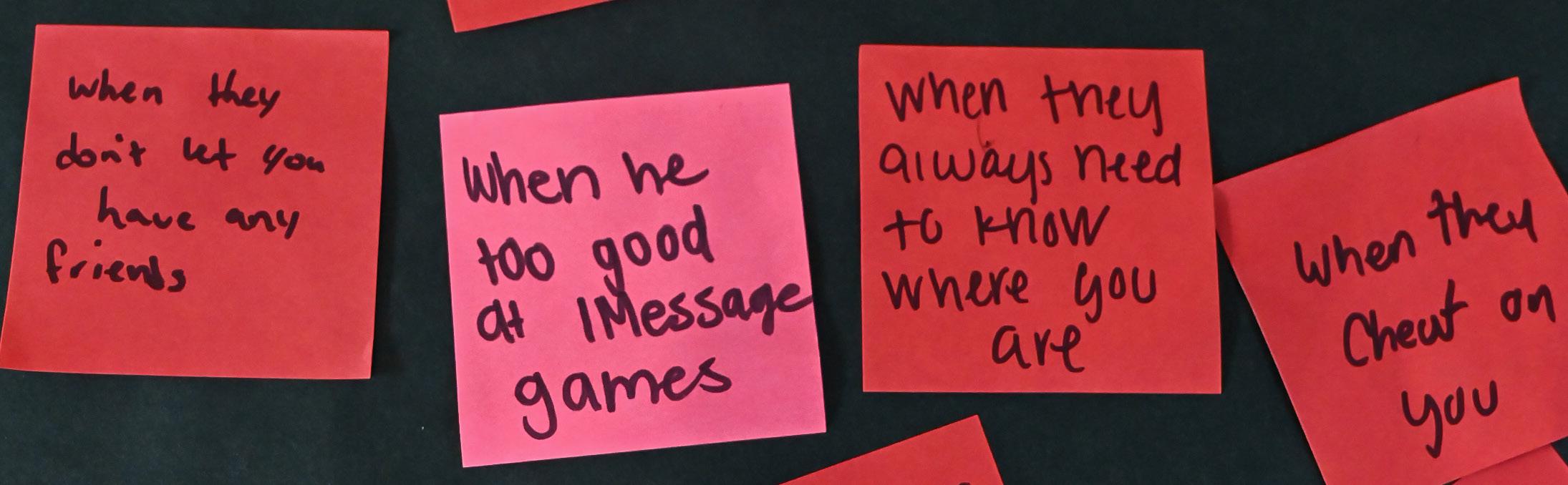
Camacho said she realized that there wasn’t enough education about the issue to help people, like Grant and her friend, avoid these abuses. She now travels around Dallas County to speak with anybody who will listen.
Gaslighting is a form of psychological manipulation where the abuser attempts to sow self-doubt and confusion in their victim’s mind.
“They will try to make you feel crazy for having a normal response to something crazy they did,” Camacho said.

She said victims can start to question their
surveyed 1,000 Americans on dating apps, seven out of 10 Gen Z participants said they would prefer to be in a relationship that has lovebombing compared to dating someone who is not committed.
“We’re starting to see this uptick in thinking that ‘I’d rather have someone give me an overwhelming amount of love and affection versus me having to work on that communication skill.’ But this is unfortunately extremely toxic since everything moves so quickly,” Camacho said.

Grant started to notice her friend retreating as the relationship got more serious. When she asked questions and brought up concerns about her friend’s boyfriend, she would be shut out.
Love-bombing can include excessive giftgiving, which can seem like an act of kindness instead of a manipulation technique at first.
Psychology major Layla Torres saw her own mother fall victim to this.

Camacho recommends learning about what red flags to look out for, but also says that sometimes there are less obvious “yellow flags” to be aware of as well.

Guilt tripping, dismissing your concerns, silent treatment and saying “all the right things” aren’t usually the in-your-face threats people are used to watching out for, Camacho said. But they can tingle your gut instincts for a reason.
Toxic relationships or behaviors have cropped up in the media, such as in memes or in analyses of movie or TV characters. There is a history of glamorizing toxic relationships, such as Cassie and Nate in “Euphoria,” as explained in a March 2022 Cosmopolitan article.
Comparing their unhealthy relationship to physically abusive couples can reinforce the idea that they don’t have it that bad, and that it could always be worse.
Love-bombing, another toxic behavior, can be difficult to understand when it’s happening to you, Camacho said.
She defines it as “when a person you are dating moves at lightning speed, taking things way too seriously way too early in the relationship.”
However, according to a blind study that
“My dad left when I was a baby, and my mom told me he wasn’t a nice guy,” Torres said. “So, when she started dating a new guy when I was a teenager, and he bought her flowers all the time and even got me candy and new clothes and stuff, I really thought he was cool.”
But as time went on, she started to question his real intentions.
“My mom would be crying in the kitchen because of something he said or did, but then two days later she would act like nothing ever happened. Like he was the best person ever,” Torres said. “I couldn’t stand it. He made her feel like dirt until he bought her something new to try to prove that he wasn’t a bad guy.”
“When someone is exhibiting examples of yellow flags or red flags, we’ve realized that there is a trend of trying to sell it as a funny kind of relationship,” Camacho said. “When in reality people do end up getting hurt, maybe not physically, but there is so much emotional scarring and verbal abuse.”
Watching out for these emotionally abusive flags is step one. But if someone has already fallen victim to such behaviors, Camacho says the key is believing them.
“Don’t judge them,” she said. “As much as we want to speak honestly and just tell them to get rid of this person, there’s a lot of manipulation that goes into very toxic relationships. So just be very honest with ourselves and know about your resources, and guide them to the experts. And know your limits. If all you can offer is a hug and a judgment-free zone, do that. And hold their hand while they work through it with the professionals who are trained for this.”

Anime has continued to grow popular and I’ve found myself looking back at what the genre was when I was growing up. Popular anime tends to trend toward male leads. In celebration of Women’s History Month, here’s a look at five standout series’ with female leads I feel are overlooked.

‘Vampire Princess Miyu’
Released: 1997
Genre: Horror
Based on a Shōjo manga of the same name, this anime focuses on Miyu Yamano, high school girl by day, guardian vampire by night. Her goal as guardian is to send demons known as shinma back to their original dimension, simply called “The Darkness.” This story has had two adaptations, and I liked this portrayal of Miyu most. Miyu starts out as an amoral character who’s just doing her job, caring little for humanity. While hunting a demon she befriends three classmates, Chisato, Yukari and Hisae.
The way Miyu develops over the course of the series as she grows
closer to the girls and faces different demons made this one a thoroughly enjoyable watch.
‘Blood+’
Released: 2005
Genre: Horror
Inspired by the 2001 anime film “Blood: The Last Vampire,” “Blood+” tells an exciting narrative with one of my favorite female leads. We follow Saya Otonashi, a young amnesiac whose life is turned upside down when she’s attacked by a blood-sucking creature known as a chiropteran. She discovers her blood is the key to fighting back against these beasts, and infuses it into a katana she uses to defeat them. When her father is killed by one, her life is upended and she’s forced to help a secret organization known as the red shield combat the chiropteran threat.
Saya strongly identifies as human despite being a chiropteran, providing an interesting juxtaposition as she’s forced to face her past lives and the hidden truths about herself while contending with her current identity. Her harrowing journey and well-written character are a couple of reasons reasons why Saya Otonashi is one of my favorite female leads in all of anime.
‘Puella Magi Madoka Magica’
Released: 2011 Genre: Fantasy
Two girls are offered any wish they desire in exchange for becoming “magical girls” and protecting the world from creatures known as witches. I loved this show’s Faustian take on the usually light-hearted magical girl genre. Madoka Kaname is our lead here. She’s a young girl who’s insecure about just how unremarkable she is. Becoming a magical girl is very appealing to her, but when she witnesses the horrid life magical girls lead she has second thoughts. This becomes more complicated when her friend is tempted to become a magical girl herself, and Madoka has no way to protect her. While the narrative does revolve around Madoka, the female cast members each bring something different to the story. Despite how cute and colorful the show is, it tackles some heavy themes like depression, rage, regret, suicide and more.
‘Ergo Proxy’
Released: 2006 Genre: Sci-Fi
In the futuristic city of Romdeau, machines called autorievs are
becoming infected by a virus called Cogito, which gives them sentience. While looking into these incidents, investigator Re-L Mayer is attacked by a monster, called a proxy, and finds herself wrapped up in an elaborate mystery involving her subordinate Vincent Law and the top echelons of the city.
As a lead character, I found Re-L Mayer quite endearing. On one hand she’s a tough, no-nonsense cop, and on the other she’s a spoiled bratty young woman whose grandfather is regent to the city. There’s an interesting parallel between the autoriev machines and Re-L as she comes to an awakening. Her character journey is a fascinating one as she’s pushed to the edge in pursuit of the truth and goes through a dramatic personality change throughout the series.
‘Michiko Hatchin’
Released: 2008
Genre: Crime
Fugitive criminal Michiko Malandra searches for her presumably deceased lover, Hiroshi Morenos, with his estranged daughter Hana, or Hatchin. This underrated show is notable for many aspects, especially its two leading ladies. Michiko is a childish, impulsive and arrogant
criminal while Hana is a more reserved, mature and intelligent young girl. Their contrasting personalities lead to an entertaining dynamic. Initially they have an antagonist relationship but through their travels they change and come to support one another. They’re both searching for a sense of freedom, Hana from her abusive family and Michiko from the long arm of the law.
Throughout it’s 22-episode run, “Michiko Hatchin” was a thoroughly entertaining action-adventure with some really touching moments, and I can’t recommend it enough.
March 8 Baseball at Cedar Valley noon
March 10 Baseball vs. Cedar Valley noon
March 11 Baseball vs. Cedar Valley noon
March 14 Baseball vs. Joliet (DH) 1 p.m.
March 20 Baseball vs. Dallas Christian noon
March 22 Baseball vs. Brookhaven noon

Sophomore shortstop Hunter
O’Shea has been a big part of the Eastfield baseball team’s recent success, hitting .296 with 13 home runs, 110 RBIs, 125 runs scored and 31 stolen bases in his career. He helped lead the Harvester Bees to the NJCAA World Series in 2022 and to the No.1 ranking in the Division III national poll this season. O’Shea sat down with Et Cetera photo editor Rory Moore to discuss his relationship with the team and what baseball means to him.

QWhat got you into baseball in the first place, and how important is it in your life?
AWhen I was younger, my sister played softball, so going to all her games motivated me to play baseball. I've been playing since I was like 4 or 5. And it's pretty big in my life. I've been playing ever since then.
QWhat was it like to play in the NJCAA World Series, and has that experience helped motivate you for this year? A
Oh, yeah. It has definitely motivated me. It was a different feeling. It was different than any other game I've ever played. It was a crazy atmosphere. It was just all around a great experience. Q
What are your expectations for this year’s team after making it to the World Series last year? A
Go back and do it again. But this time, win.
Q What's the biggest highlight in your baseball career so far? A
That’s a tough one. Probably just going to the World Series honestly. It's perhaps the biggest stage I’ve ever played on.
more in high school, I was at a 6A high school. We were a pretty big name. I didn't play much. My hitting wasn’t there, so it really took a lot mentally for me to just be able to overcome that and start doing what I needed to do and challenge myself more than ever.
Q Is there a walk-up song that you have during the games?
you admire most and why?
AI'd have to say Jose Altuve because, as short as he is, he made it happen with a lot of hard work and dedication. And he's one of the best second basemen to play in the major leagues right now.
good. The pitchers fill it up and throw a lot of strikes. We can be great. We’re just not hitting like we should right now, but there's a lot of good stuff on the offensive side. Everything's just got to click. Pitchers get those strikes. Hitters got to hit. Defensively, we're solid.
QHow would you describe your relationship with the coaching staff?
A Oh, great. I love them; they love me. They're like my second family. You know, we're all pretty close. We laugh, have fun, but when it's time to work, it's time to work.
QWhat are your interests outside of baseball and school?
AI like to fish, hang out with friends, the usual. I’m a big video game guy. I’ve got a built PC at home, so I spend a lot of the time there.
QWhat video games do you like to play? A “Call of Duty,” “Rocket League” and “Rainbow Six Siege.”
Q
Oh, yeah. When I was a sopho-
Have you had to overcome any challenges in your journey so far? A
A Yeah, it's ”25k Jacket” by Lil Baby.
Q Do you have a pro player that
Q What would you say are the team's biggest strengths, and what do you think it will take to reach your goals in the future?
A Our pitching this year is very
QWhat are your plans after Eastfield?
A I'm not quite sure honestly. Either go play (baseball) or call it quits and go work and start a life.
The Eastfield Harvester Bees missed their opportunity to secure an automatic bid to the national tournament, losing 96-92 to Richland on Friday in the semifinals of the South Central District Tournament at North Lake.


“I’m totally upset about it,” Eastfield coach Dexter Young said. “There’s nothing more I wanted than to win a tournament and make it to nationals.”
However, even with the loss, Young is hopeful that Eastfield will receive an at-large bid. The tournament field will be announced at 1 p.m. Wednesday. North Lake went on to win the tournament, and the Blazers will try to defend their title in the national tournament.
The Harvester Bees were leading the semifinal game against Richland 50-35 at halftime and seemed to be in control. But it all went downhill in the second half when they lost that momentum and were outscored 61-42 by the Thunderducks.
“We got comfortable and stopped fighting and stopped putting pressure [on them],” Young said. “They came back fighting. We took the pressure off, and they put the pressure on.”
This is the second time this season Eastfield
has lost a lead against Richland. On Feb. 8, the Harvester Bees led 60-52 at halftime and were outscored 57-45 in the second half.
Eastfield struggled to hit shots in the tournament. The team averaged 34.7% shooting from behind the three-point line this season but only shot 25% (6-for-24) against Richland. Their 92-point total was well below their season average of 109.7 points per game.
Forward Dwayne Reliford was the only Eastfield starter in double digits, posting a double-double with 22 points with 14 rebounds. Reserve guard Jacore Williams also had a double-double with 20 points and 10 rebounds. Tylan Harris added 14 points and Torian Harris had 11.

Young said his team learned a lot during his first season as head coach.
“There’s going to be a lot of adversity,” he said. “There’s going to be a lot of ups and downs. But basically, like in a game, every team has runs, and you have to be willing to fight. It’s just learning. The game is more mental than physical, and we have to get stronger mentally.”
Young has his eyes set on the future and is already recruiting the next group of Harvester Bees.
“We're going to dominate, and I'm saying that to everybody. They know,” he said. “The guys I bring in are just tough.”
Award-winning member of:
• Texas Intercollegiate Press Association

• Texas Community College Journalism Association
Dallas College Eastfield Campus
3737 Motley Drive Mesquite, TX 75150
Phone: 972-860-7130
Email: etc4640@dcccd.edu
Editor in Chief
Moira McIntee
Managing Editor
Carmen Guzman
Presentation Editor
Mattheau Faught

Photo Editor Rory Moore
Page Designer
Breanna Hernandez
Graphic Designers
Veronica Trejo
Janet Balsadua
Photographer/Designer
Christian Taylor
Contributors
Clark Mandigo IV
Sean Stroud
Jose E. Rivera
Anthony Rosado
Publication Adviser
Elizabeth Langton
Student Media Adviser
Natalie Webster
Faculty Adviser
Lori Dann
The views expressed on the opinion pages and other opinion pieces and cartoons in this publication are those of the author and do not necessarily represent the views of The Et Cetera, Dallas College. The Et Cetera is published by a student staff.
First Amendment Right Congress shall make no law respecting an establishment of religion, or prohibiting the free exercise thereof; or abridging the freedom of speech, or of the press; or the right of the people peaceably to assemble, and to petition the government for a redress of grievances.
Letters to the Editor
Letters must be typed, signed and include a phone number. Letters will be edited for profanity and vulgarity, Associated Press style, grammar, libel and space when needed. The content will remain that of the author. Letters should be no longer than 250 words.
Culinary student Preston Nguyen prepares chilaquiles in his Arlington home. He served the dish to Gordon Ramsay on “Next Level Chef.” Photo by Rory Moore/The Et Cetera.
Gov. Greg Abbott is targeting buzzwords for his latest political play: transgender, critical race theory and TikTok. Now, diversity, equity and inclusion hiring policies have caught his ire.

Our DEI program seemed like it was here to stay prior to the governor’s office issuing a memo on Feb. 7 ceasing the implementation of DEI policies in state agencies, branding the practice as “employment discrimination.”
With approximately 60% of the Texas population identifying as a race other than white, according to the most recent Census Bureau statistics, it seems incredulous that the governor is actively working against the very people who make up the state he is meant to represent.
The governor has failed to explain why DEI policies are illegal under current employment laws, save for a fallacy that creating diversity inherently promotes discrimination.
Institutions such as the University of Texas System have already rolled back such practices, and it looks like more dominoes will fall.
Dallas College falls right in line
with state demographics: 64.6% of our student body is made up of nonwhite identifying students. Our active personnel statistics are almost a mirror image, with 63% identifying as a race other than white. This includes facuty, administration and other staff positions such as success coaches and admission specialists.
Hiring staff who are representative of our student body is important. The opportunity to see the faces of instructors and student support positions who look like them can be an inspiration for many minority students.
A research article published by the Review of Educational Research
reflects the positive impact of student-teacher racial and ethnic matching.
“Black and Latino/a students (1) receive more favorable ratings of classroom behavior and academic performance, (2) score higher on standardized tests, and (3) have more positive behavioral outcomes when assigned to a teacher of the same race/ethnicity,” according to the article.
Our incredible diversity at Dallas College has been a point of pride. The administration has consistently supported multicultural, LGBTQ and other events that celebrate diversity throughout the years.
The National Association for the Advancement of Colored People and civil rights leaders are already trying to take a legal stand against Abbott’s attack on diversity.
Eliminating diversity hiring practices is only going to hurt the students and communities they were originally created to support. The fact that the Texas government is consistently attempting to stifle the qualities that make this college a refuge for many is a disservice to everyone.
Texans hate being last, but when it comes to sports betting, we’re pretty close to it.
In Texas, betting on sports is completely illegal, unlike in 36 states and Washington D.C., which all allow it.
This matter has come up in the Texas Legislature multiple times, much to the chamber’s disapproval.
Since the legislature meets every odd-numbered year, they didn’t meet about the subject of betting on sports until this January. Recently, a wave of states, including Maine, Nebraska and Massachusetts, have passed laws to legalize sports gambling. It’s time for Texas to hop on board and start playing too.
There are many loopholes already that allow people to gamble on sports if they put in the effort, including offshore betting websites based in different countries that do not need to follow Texas or U.S. government laws and restrictions. It’s safe to say that Texans are already using these
Clark Mandigo Contributor @TheEtCeterasites to bet on sports.
If someone wants to bet on hockey, football, soccer, basketball, you name the game, even if the state doesn’t legalize it, they can find a way. There’s an even more logical reason for legalizing sports betting: revenue. It is estimated that Texas is missing out on $1.3 billion in sports betting revenue from this year’s NCAA basketball tournament.
The Texas Tribune reports that Christian groups are traditionally against the expansion of gambling. There are also opponents who don’t
want to see big resort corporations making money off Texans and slot machines in convenience stores.
However, a Jan. 26 study by the Hobby School of Public Affairs at the University of Houston discovered that 75% of Texans support a proposed constitutional amendment that would legalize sports betting and allow for up to four upscale “destination resorts.”
Texas Sen. Lois Kolkhors and Rep. Jeff Leach filed bills to legalize mobile sports betting in February. The proposed legislation “is the first step in the process of getting a required amendment to the Texas constitution to legalize sports wagering in the state,” according to a recent article on the GamingToday website.
Texas is finally taking the right strides to legalize sports betting, hopefully finally joining the other states that have already done so.
So maybe Texas won’t be last in sports betting after all.
“When I’m gone, please don’t release any posthumous albums or songs with my name attached. Those were just demos and never intended to be heard by the public.” This is what Anderson Paak has inked on his arm.
I’ll admit I gave a disapproving nod when I first saw the news scroll by on Instagram. At the time it seemed a bit overdramatic, but after living through the release of Pop Smoke and XXXtentacion’s posthumous music and recent announcement of an NFT collection in honor of what would have been J. Dilla’s 49th birthday, I think Paak’s message has finally set in.
It’s an unfortunate reality that the music business and an early untimely death seem to go hand-in-hand. From Robert Johnson’s deal with the devil to Amy Winehouse’s overdose, there doesn’t seem to be any discrimination as to time, genre or vice when it comes to those afflicted.
No one can plan for death, so that leaves the question: What is to be done with what they leave behind?
Paak has made sure there’s no confusion on his stance. The preservation of someone’s legacy is a delicate task, and all too often it falls into the wrong hands.
The first two albums by Jahseh Onfroy (XXXtentacion) – “17” and “?” – were wellreceived critically, and he garnered respect for his willingness to innovate and step outside his genre-imposed boundaries.
Following his murder in 2018, two albums were released by his estate posthumously, “Skins” and “Bad Vibes Forever,” neither of which was as good as his previous two. “Skins” received notably negative reviews compared to its predecessors. It was criticized resoundingly for its failure to carry on with X’s creative
expansion and its unfinished sound.
The album did debut at No. 1 on the Billboard Hot 200 list, but I’d chalk that up to anticipation from fans rather than the music’s quality. It only took three weeks for “Skins” to fall below “?” on the charts at 31 and 22, respectively. Comparatively, “?” debuted at No. 1 and spent five weeks in the Top 10.
“Bad Vibes Forever” was a similar story when it came to critical reception, for many of the same reasons. Commercially, it debuted at No. 5 on the Hot 200, a real disappointment considering his two previous No. 1 debuts and “17” debut at No. 2. Overall, the album feels more like a cash grab from the estate than a deserving addition to Onfroy’s discography.
Unfortunately the exploitation doesn't stop there. About a month after his untimely demise, Onfroy’s estate launched his clothing line, starting with a remembrance collection. There’s nothing inherently wrong with that, but the numerous uninspired releases of diminishing quality that followed prove there is no passion behind this.
The legacy of Bashar Jackson, or Pop Smoke, shares a similar fate. After his murder during a home invasion in 2020, 50 Cent signed on to be the executive producer of his posthumous debut album. With his “Meet The
Woo 2” mixtape, released just 12 days before his death, landing Jackson his first Top 10 spot in the Hot 200 at No. 7, there were high expectations for whatever was to follow.
Despite its commercial success, “Shoot For The Stars, Aim For The Moon” received worse reviews than Jackson’s prior two mixtapes. Many chalk this up to the long list of big-name features overshadowing the drill sound that Pop Smoke had popularized and mastered.
His second posthumous release, “Faith,” received mostly negative reviews, with critics harping on the same issues as the last album. While it debuted at No. 1 on the Billboard Hot 200, making Pop Smoke the first artist to have two No. 1 albums posthumously, it only took two weeks for it to fall below its predecessor on the charts.
Starting to notice a trend? Yes, there are moments where these stars wrestle past the featured artist that paid their way onto the track and shine through the hasty production slapped on top of their voice memo recordings. But overall, the result is the same: This is a disgrace to their legacies. It doesn’t have to end this way, and frankly, they deserve better.
While it’s a horrendous act to tarnish what someone has left behind, I have no doubt that money-hungry inheritors will continue to do what’s in the best interest of lining their coffers rather than upholding the image of those who can no longer do so themselves.
Despite the multiple examples we have of awful attempts of posthumous music releases, there is at least one time that it was carried out successfully and respectfully.
After the tragic loss of Mac Miller to laced pills in 2018, fans were devastated. Since his first release at 15, Miller had undergone many

creative metamorphoses and matured as an artist, gradually cultivating his own unique style that’s on full display on “Swimming,” his fifth studio album released just a month prior to his death.
To follow up this album with another body of work that would honor and build upon what Miller had left behind was a task that required an immense deal of grace and tact. Luckily for us, Jon Brion was up to it.
As a producer who had worked with Miller on “Swimming” and had been working with him on his next release at the time of his passing, Brion went on to finish producing the album based on his conversations with Miller and his overall vision for the album.
Since its release, “Circles” has been praised by critics and fans alike for its continuation of Miller’s artistic maturation and serves as a fitting bookend for his body of work. Other than this, Miller’s estate has only made old mixtapes like “Faces” and “I Love Life, Thank You” available on streaming services.
Miller’s legacy is secure and unharmed because everything released after his death was either somewhat finished or planned out with a good idea of where to take it when he died and because they found someone trustworthy and capable of finishing his work in Brion. It was the ideal situation. Anything less than this should not be released, and I would consider it sacrilege.
I, for one, have started looking more closely and with a more discerning eye at merch and music released after an artist’s death and choose to abstain from supporting contemptible products. For the sake of preserving the honor and sanctity of music’s culture, I hope you’ll do the same.
When immigrant students are trying to adapt to a U.S. college, there are several roadblocks they face.
It isn’t easy to assimilate to a new country’s culture when you’re a teenager or young adult. The “age of arrival to the U.S. plays a role in the educational outcomes of immigrant students,” according to the Postsecondary National Policy Institute.
If you moved to the U.S. as a young child, your cultural assimilation process began early. But if you already finished high school in Mexico, or were en route to obtain your diploma there, you will encounter barriers that sometimes feel unsurmountable.
The first barrier is language. Immigrant students who graduated from high school in Mexico and take college-level courses may find the courses especially difficult because their English is not sufficient. In my experience, translating written documents was easy, but speaking and writing the language was not.

If a student was enrolled in a high school
in Mexico but finished high school in the U.S., the difficulties encountered due to the lack of language skills probably impacted them emotionally. Low self-esteem and low academic expectations likely affected their test scores that were needed to enroll in college.
Dallas College makes a lot of effort to minimize the language barrier by offering Spanishspeaking staff in admissions, bilingual student advisers, personalized guidance assistance and individual coaching.
However, another barrier is money. Many immigrant Mexican students lack the econom-
ic resources to pay for college.
Dallas College has programs like TRIO, Upward Bound, Title V and others that help pay their tuition, but many Mexican high school graduates do not know about them, or do not qualify. If they graduated from a U.S. high school, they might not have enough information either.
The dropout rate of immigrants who enroll in community college is high. Several years ago, I worked as a City of Dallas employee assigned to middle and high schools.
While coordinating support groups for students at risk of dropping out, I noticed a lot of them were first-generation Mexican immigrants. Some already experienced school burnout due to the energy spent assimilating themselves to the U.S. educational system.
The college experience looked like a very distant and uneasy future.
If they enrolled in community college, the academic pressures in addition to burnout and emotional distress caused massive dropout
rates. According to PNPI statistics, in 2016, 19% of immigrants aged 25 and older had obtained a two-year degree or attended some college, compared to 31% of their peers born in the U.S.
When you have some college work in a Mexican university like me, the transition from one system to the other is smoother. However, that is not the case for many Dallas College students.
Immigrant students should start with English language courses, then add a few other courses, gradually increasing in number and difficulty. They should also look into financial aid as soon as possible to help ease the transition to a new learning environment.
I recommend immigrant students ask college staff about the free Spanish counseling, career planning and all other services available to them. Taking advantage of these could help them graduate or transfer to a four-year institution, independently of the length of time they need to achieve their educational goals.
Continued from Page 2
my junior year, I went to the program for an internship. I hated that job.”
A desk job wasn’t in the cards for Nguyen.
He needed something more hands-on, so he turned back to his hobby.
Nguyen enrolled in Dallas College and made the switch to culinary arts.
Initially, he didn’t dream of entering the competitive scene. He volunteered at the World Food Championships as a helper for extra credit, but joined the contest when he heard of an open slot.

“Sometimes you have somebody that’s very talented, but they’re not willing to put in the hard work … and that is not the case with Preston,” culinary instructor Jesmary Sbraga said. “He’s very humble and wellrounded.”
Fine-dining sites have noticed the victories under Nguyen’s belt; he works at Prince Lebanese Grill in Arlington and cooked at The Mansion Restaurant in Dallas. He balances schoolwork with shifts that have gone on for 18 hours.
“It was cool to experience being an adult in the culinary scene,” he said.
Nguyen stays in touch with his classmates and instructors. The sense of community in his culinary classes became his favorite part of the program.
“The cool thing about culinary school is that you’re going to meet a lot of people who are also passionate about food,” Nguyen said.
One assignment in Glick’s advanced class features a mystery basket with unknown ingredients. His students are required to cook with what they get.
Nguyen crafted a chicken quarter with his random assortment of ingredients.
“I was absolutely blown away by his presentation,” Glick said. “I think we all were. It was an exquisite visual presentation. ... He’s one hell of
a cook.”
Even though he’s made advancements in his career, Nguyen feels like he still has a lot to learn about being a professional chef.
It’s more difficult for him to be satisfied with his creations since his cooking was put on a pedestal.
“I’m my biggest critic,” he said. “Every dish I put out, my first question is 'what I can do to improve upon it?'”
While in a fine-dining kitchen, Nguyen learned techniques such as quality control and sophistication in a high-pressure, fast-moving environment.
“You have to make [food] look like art,” he said. “There’s this higher level of expectation that you really have to put on everything.”
Whenever Nguyen crafts a dish at home, his camera takes the first bite. His house has a nook where he prepares food photos for his Instagram account, @theculinarycode.
“It helps to look at it through the camera. You see what pops out and what doesn’t,” he said.
Color is quintessential to Nguyen’s dishes.
He views them as art pieces, and his most enticing meals contain vibrant hues.
A “good balance of color” is key, he said.
Nguyen’s biggest fans are his family, and he’s always trying to find new ways to reinvent dinner.
“Food and family are his core values,” said Emma Nguyen, Preston’s mother. “People saw that during the World Food competitions – it was us, as a family, cooking food.”
Family-owned restaurants are a tradition in the Nguyen family. Preston’s relatives have owned a Brazilian
Continued from Page 5
ability to do their jobs. Where it may replace some rudimentary tasks, the person will likely be doing something more advanced.”
Journalists have also expressed concerns about being replaced, especially in light of the recent CNET scandal. Hyde argues that journalism is far too sophisticated a job to be supplemented by an AI given the
amount of deep research involved.
CNET did have some errors in the AI-generated articles like basic math being wrong. Given the quantity of work AI can produce it would likely be beneficial to hire staff to do the proper editing and research that needs to be done. Hyde says writers, editors and researchers well versed in using AI-based tech are more likely to be hired, thus would be wise to learn the technology.
“What it will probably do is just take what the person wrote and generate a lot more news releases and

steakhouse, a Vietnamese kitchen, several Mexican restaurants and a pastry shop.
Nguyen is continuing the pattern with the restaurant he plans to open with his family someday. His father dreams of seeing his son work in a setting like that.
“It’s great he can have a career doing something he loves,” Peter Nguyen said. “It brings everyone closer because everyone eats. ... Food is real important in our lives.”
Although Preston thinks his cooking will never exceed the quality of a homemade dinner cooked by a loving mother, the passive competition in his family kitchen keeps him on his toes.
“It’s wonderful that he’s able to cook us a wonderful meal. I’m like, ‘Yes, we’re gonna have a really good dinner tonight,’” Emma said. “The other night he made a rack of lamb, and it was phenomenal.”
However, after a hard-fought competition like ‘“Next Level Chef,” the Nguyen family settled for nachos while watching the premiere.
“When I first popped up on TV, everybody screamed so loud I couldn’t hear what was going on,”
Nguyen said.
Having his food judged by Ramsay was a high-pressure situation that felt novel, but Nguyen found his ways to keep cool in the midst of the celebrity chef’s notorious insults.
“We had a bingo card,” Nguyen said. “Idiot sandwich, raw, lamb sauce – he said all those things.”
There are moments when Nguyen wonders what he could’ve done differently, how he could’ve seasoned his dish or seared a steak.
That was the case with the chilaquiles he made for Ramsay. After pouring the sauce into a bowl of chips, then decorating the crunchy tortilla fragments with bits of red onion, cilantro and seasonings, he let the stew settle for a while to get the chips soggy.
There wasn’t time to do so when Nguyen served it to Ramsay. Working fast caused the dish to fall short of his expectations.
But it didn’t matter in the end because Nguyen’s parents, quietly observing him from a distance, believed in the final product being another taste to remember.
“They’re my biggest supporters –since day one,” Nguyen said.
they can spend some time editing the material generated and be able to do other tasks AI cannot do,” Hyde said. “For example, AI cannot pick up a phone and call you to pitch a story.”
Hyde also argued that the onus is on the humans using this technology to make sure their information is factual and correct since, like Tolle pointed out, it is subject to error.
“Buzzfeed is not going to be able to say this is just going to be created by an AI and go straight to the website without anybody looking at it first,” Tolle said.