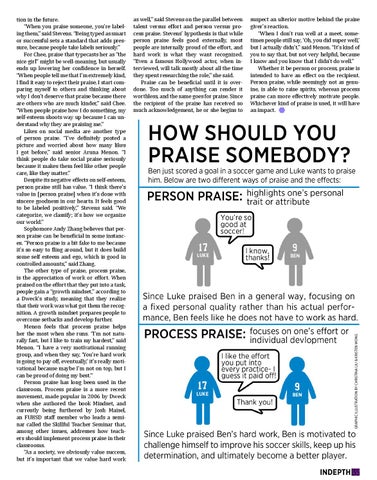
as well,” said Stevens on the parallel between talent versus effort and person versus process praise. Stevens’ hypothesis is that while person praise feels good externally, most people are internally proud of the effort, and hard work is what they want recognized. “Even a famous Hollywood actor, when interviewed, will talk mostly about all the time they spent researching the role,” she said. Praise can be beneficial until it is overdone. Too much of anything can render it worthless, and the same goes for praise. Since the recipient of the praise has received so much acknowledgement, he or she begins to
suspect an ulterior motive behind the praise giver’s reaction. “When I don’t run well at a meet, sometimes people still say, ‘Oh, you did super well,’ but I actually didn’t,” said Menon. “It’s kind of you to say that, but not very helpful, because I know and you know that I didn’t do well.” Whether it be person or process, praise is intended to have an effect on the recipient. Person praise, while seemingly not as genuine, is able to raise spirits, whereas process praise can more effectively motivate people. Whichever kind of praise is used, it will have an impact.
GRAPHIC ILLUSTRATION BY CHRISTINA LIU & KRISTEN WONG
tion in the future. “When you praise someone, you’re labeling them,” said Stevens. “Being typed as smart or successful sets a standard that adds pressure, because people take labels seriously.” For Chee, praise that typecasts her as “the nice girl” might be well-meaning, but usually ends up lowering her confidence in herself. “When people tell me that I’m extremely kind, I find it easy to reject their praise. I start comparing myself to others and thinking about why I don’t deserve that praise because there are others who are much kinder,” said Chee. “When people praise how I do something, my self-esteem shoots way up because I can understand why they are praising me.” Likes on social media are another type of person praise. “I’ve definitely posted a picture and worried about how many likes I got before,” said senior Aruna Menon. “I think people do take social praise seriously because it makes them feel like other people care, like they matter.” Despite its negative effects on self-esteem, person praise still has value. “I think there’s value in [person praise] when it’s done with sincere goodness in our hearts. It feels good to be labeled positively,” Stevens said. “We categorize, we classify; it’s how we organize our world.” Sophomore Andy Zhang believes that person praise can be beneficial in some instances. “Person praise is a bit fake to me because it’s so easy to fling around, but it does build some self esteem and ego, which is good in controlled amounts,” said Zhang. The other type of praise, process praise, is the appreciation of work or effort. When praised on the effort that they put into a task, people gain a “growth mindset,” according to a Dweck’s study, meaning that they realize that their work was what got them the recognition. A growth mindset prepares people to overcome setbacks and develop further. Menon feels that process praise helps her the most when she runs. “I’m not naturally fast, but I like to train my hardest,” said Menon. “I have a very motivational running group, and when they say, ‘You’re hard work is going to pay off, eventually,’ it’s really motivational because maybe I’m not on top, but I can be proud of doing my best.” Person praise has long been used in the classroom. Process praise is a more recent movement, made popular in 2006 by Dweck when she authored the book Mindset, and currently being furthered by Josh Maisel, an FUHSD staff member who leads a seminar called the Skillful Teacher Seminar that, among other issues, addresses how teachers should implement process praise in their classrooms. “As a society, we obviously value success, but it’s important that we value hard work