LIVING COLOUR: THE MET MUSEUM’S TEMPLE OF DENDUR
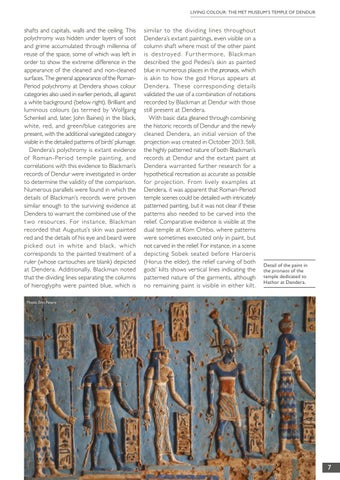
shafts and capitals, walls and the ceiling. This polychromy was hidden under layers of soot and grime accumulated through millennia of reuse of the space, some of which was left in order to show the extreme difference in the appearance of the cleaned and non-cleaned surfaces. The general appearance of the RomanPeriod polychromy at Dendera shows colour categories also used in earlier periods, all against a white background (below right). Brilliant and luminous colours (as termed by Wolfgang Schenkel and, later, John Baines) in the black, white, red, and green/blue categories are present, with the additional variegated category visible in the detailed patterns of birds’ plumage. Dendera’s polychromy is extant evidence of Roman-Period temple painting, and correlations with this evidence to Blackman’s records of Dendur were investigated in order to determine the validity of the comparison. Numerous parallels were found in which the details of Blackman’s records were proven similar enough to the surviving evidence at Dendera to warrant the combined use of the two resources. For instance, Blackman recorded that Augustus’s skin was painted red and the details of his eye and beard were picked out in white and black , which corresponds to the painted treatment of a ruler (whose cartouches are blank) depicted at Dendera. Additionally, Blackman noted that the dividing lines separating the columns of hieroglyphs were painted blue, which is
similar to the dividing lines throughout Dendera’s extant paintings, even visible on a column shaft where most of the other paint is des troyed. Fur ther mor e, B lack man described the god Pedesi’s skin as painted blue in numerous places in the pronaos, which is akin to how the god Horus appears at Dendera. These corresponding details validated the use of a combination of notations recorded by Blackman at Dendur with those still present at Dendera. With basic data gleaned through combining the historic records of Dendur and the newly cleaned Dendera, an initial version of the projection was created in October 2013. Still, the highly patterned nature of both Blackman’s records at Dendur and the extant paint at Dendera warranted further research for a hypothetical recreation as accurate as possible for projection. From lively examples at Dendera, it was apparent that Roman-Period temple scenes could be detailed with intricately patterned painting, but it was not clear if these patterns also needed to be carved into the relief. Comparative evidence is visible at the dual temple at Kom Ombo, where patterns were sometimes executed only in paint, but not carved in the relief. For instance, in a scene depicting Sobek seated before Haroeris (Horus the elder), the relief carving of both gods’ kilts shows vertical lines indicating the patterned nature of the garments, although no remaining paint is visible in either kilt.
Detail of the paint in the pronaos of the temple dedicated to Hathor at Dendera.
Photo: Erin Peters
EGYPTIAN ARCHAEOLOGY ISSUE NO 50 SPRING 2017
7