Photo: Erin Peters
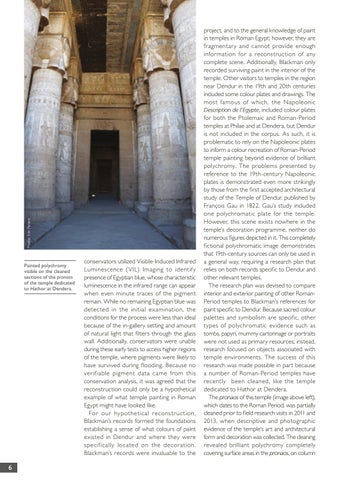
Painted polychromy visible on the cleaned sections of the pronaos of the temple dedicated to Hathor at Dendera.
6
conservators utilized Visible-Induced Infrared Luminescence (VIL) Imaging to identify presence of Egyptian blue, whose characteristic luminescence in the infrared range can appear when even minute traces of the pigment remain. While no remaining Egyptian blue was detected in the initial examination, the conditions for the process were less than ideal because of the in-gallery setting and amount of natural light that filters through the glass wall. Additionally, conservators were unable during these early tests to access higher regions of the temple, where pigments were likely to have survived during flooding. Because no verif iable pigment data came from this conservation analysis, it was agreed that the reconstruction could only be a hypothetical example of what temple painting in Roman Egypt might have looked like. For our hypothetical reconstruc tion, Blackman’s records formed the foundations establishing a sense of what colours of paint existed in Dendur and where they were specif ically located on the decoration. Blackman’s records were invaluable to the
project, and to the general knowledge of paint in temples in Roman Egypt; however, they are fragmentary and cannot provide enough information for a reconstruction of any complete scene. Additionally, Blackman only recorded surviving paint in the interior of the temple. Other visitors to temples in the region near Dendur in the 19th and 20th centuries included some colour plates and drawings. The most famous of which, the Napoleonic Description de l’Egypte, included colour plates for both the Ptolemaic and Roman-Period temples at Philae and at Dendera, but Dendur is not included in the corpus. As such, it is problematic to rely on the Napoleonic plates to inform a colour recreation of Roman-Period temple painting beyond evidence of brilliant polychromy. The problems presented by reference to the 19th-century Napoleonic plates is demonstrated even more strikingly by those from the first accepted architectural study of the Temple of Dendur, published by François Gau in 1822. Gau’s study included one polychromatic plate for the temple. However, this scene exists nowhere in the temple’s decoration programme, neither do numerous figures depicted in it. This completely fictional polychromatic image demonstrates that 19th-century sources can only be used in a general way, requiring a research plan that relies on both records specific to Dendur and other relevant temples. The research plan was devised to compare interior and exterior painting of other RomanPeriod temples to Blackman’s references for paint specific to Dendur. Because sacred colour palettes and symbolism are specific, other types of polychromatic evidence such as tombs, papyri, mummy cartonnage or portraits were not used as primary resources; instead, research focused on objects associated with temple environments. The success of this research was made possible in part because a number of Roman-Period temples have recently been cleaned, like the temple dedicated to Hathor at Dendera. The pronaos of this temple (image above left), which dates to the Roman Period, was partially cleaned prior to field research visits in 2011 and 2013, when descriptive and photographic evidence of the temple’s art and architectural form and decoration was collected. The cleaning revealed brilliant polychromy completely covering surface areas in the pronaos, on column