LIVING COLOUR: THE MET MUSEUM’S TEMPLE OF DENDUR
Through this project, we discovered that Dendur, and other temples that date to the Roman Period in Egypt, were painted differently than those of earlier periods, in complex ways deserving of serious scholarly attention. Future research possibilities came from working collaboratively across multiple departments towards expanding visitors’ experiences with ar t. Ultimately, this ar ticle documents a successful project that unites through original scholarly research, innovation in conservation, and creativity with digital technology, the Temple of Dendur’s current life in the Metropolitan Museum of Art with its ancient life near the Nile River in Nubia, the region south of ancient Egypt’s traditional border at modern-day Aswan. The primary intent of ‘Colouring the Temple’ was to engage visitors, so we selected an area of the temple that could be easily viewed, was in good condition with little erosion, and featured deities that may be familiar to visitors. The scene is in the first register on the south exterior wall and shows Augustus as pharaoh offering wine to the popular deities Horus (in his form as Harendotes) and Hathor. We were not able to visually detect remaining paint on this scene, which was not surprising, as the temple was flooded after the building of the initial Aswan Dam in 1899-1902 and its first raising in 1907-12. The temple had not flooded before this first raising, and at that time the Egyptian Antiquities Service ordered its full sur vey and documentation, which was
conducted by Aylward Blackman and published in 1911. As part of Blackman’s survey, he noted that there were several instances of remaining paint. Blackman’s records for polychromy exist only for the interior spaces of the temple proper, and are focused on the front room, the pronaos. The interior walls of the pronaos are completely decorated with relief carving and would have been painted, as all relief carving at the temple complex probably was. The ceiling is decorated with a central panel of six vultures with alternating vulture and uraeus heads, which was bordered on either side by columns of elaborately coloured patterns, as indicated by one of Blackman’s diagrams. The remainder of the ceiling was painted blue with gold stars, symbolizing the night sky. The decoration of the south, west, and north walls is organized in two registers, bordered by a base of Nile gods processing offerings, and a running frieze of alternating vultures and khekher-pattern (a stylised design representing tied bundles or decorative knots) with significant remaining polychromy below the ceiling, also diagrammed by Blackman. Like the ceiling and the frieze, Blackman recorded some remaining paint in all scenes in the pronaos , and there was indeed a surprising amount of paint still surviving in the early 20th century. To see if the temple today could corroborate these records, technical imaging was carried out to determine if any pigment could be detected outside the visible light range. The Metropolitan Museum of Art’s
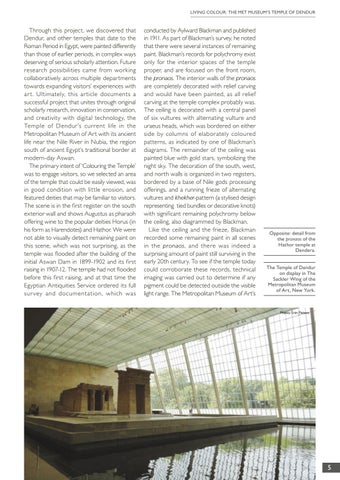
Opposite: detail from the pronaos of the Hathor temple at Dendera. The Temple of Dendur on display in The Sackler Wing of the Metropolitan Museum of Art, New York.
Photo: Erin Peters
EGYPTIAN ARCHAEOLOGY ISSUE NO 50 SPRING 2017
5