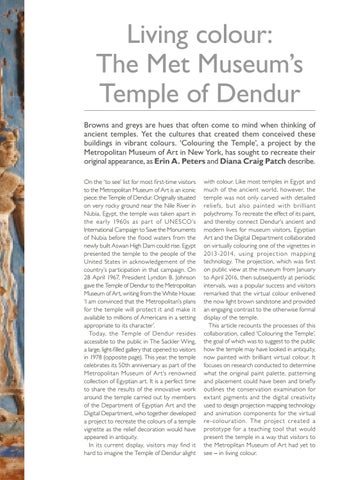
Living colour: The Met Museum’s Temple of Dendur Browns and greys are hues that often come to mind when thinking of ancient temples. Yet the cultures that created them conceived these buildings in vibrant colours. ‘Colouring the Temple’, a project by the Metropolitan Museum of Art in New York, has sought to recreate their original appearance, as Erin A. Peters and Diana Craig Patch describe. On the ‘to see’ list for most first-time visitors to the Metropolitan Museum of Art is an iconic piece: the Temple of Dendur. Originally situated on very rocky ground near the Nile River in Nubia, Egypt, the temple was taken apart in the early 1960s as par t of UNESCO’s International Campaign to Save the Monuments of Nubia before the flood waters from the newly built Aswan High Dam could rise. Egypt presented the temple to the people of the United States in acknowledgement of the country’s participation in that campaign. On 28 April 1967, President Lyndon B. Johnson gave the Temple of Dendur to the Metropolitan Museum of Art, writing from the White House: ‘I am convinced that the Metropolitan’s plans for the temple will protect it and make it available to millions of Americans in a setting appropriate to its character’. Today, the Temple of Dendur resides accessible to the public in The Sackler Wing, a large, light-filled gallery that opened to visitors in 1978 (opposite page). This year, the temple celebrates its 50th anniversary as part of the Metropolitan Museum of Ar t’s renowned collection of Egyptian art. It is a perfect time to share the results of the innovative work around the temple carried out by members of the Department of Egyptian Art and the Digital Department, who together developed a project to recreate the colours of a temple vignette as the relief decoration would have appeared in antiquity. In its current display, visitors may find it hard to imagine the Temple of Dendur alight
4
with colour. Like most temples in Egypt and much of the ancient world, however, the temple was not only carved with detailed reliefs, but also painted with br illiant polychromy. To recreate the effect of its paint, and thereby connect Dendur’s ancient and modern lives for museum visitors, Egyptian Art and the Digital Department collaborated on virtually colouring one of the vignettes in 2013 -2014, using pr ojec tion mapping technology. The projection, which was first on public view at the museum from January to April 2016, then subsequently at periodic intervals, was a popular success and visitors remarked that the virtual colour enlivened the now light brown sandstone and provided an engaging contrast to the otherwise formal display of the temple. This article recounts the processes of this collaboration, called ‘Colouring the Temple’, the goal of which was to suggest to the public how the temple may have looked in antiquity, now painted with brilliant virtual colour. It focuses on research conducted to determine what the original paint palette, patterning and placement could have been and briefly outlines the conservation examination for extant pigments and the digital creativity used to design projection mapping technology and animation components for the vir tual re-colour ation. The projec t created a prototype for a teaching tool that would present the temple in a way that visitors to the Metroplitan Museum of Art had yet to see – in living colour.