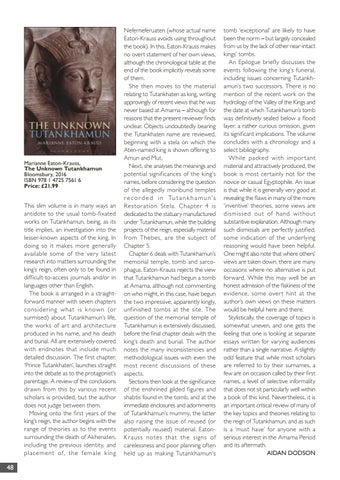
Marianne Eaton-Krauss, The Unknown Tutankhamun Bloomsbury, 2016 ISBN 978 1 4725 7561 6 Price: £21.99
This slim volume is in many ways an antidote to the usual tomb-fixated works on Tutankhamun, being, as its title implies, an investigation into the lesser-known aspects of the king. In doing so it makes more generally available some of the very latest research into matters surrounding the king’s reign, often only to be found in difficult-to-access journals and/or in languages other than English. The book is arranged in a straightforward manner with seven chapters consider ing what is k nown (or surmised) about Tutankhamun’s life, the works of ar t and architecture produced in his name, and his death and burial. All are extensively covered with endnotes that include much detailed discussion. The first chapter, ‘Prince Tutankhaten’, launches straight into the debate as to the protagonist’s parentage. A review of the conclusions drawn from this by various recent scholars is provided, but the author does not judge between them. Moving onto the first years of the king’s reign, the author begins with the range of theories as to the events surrounding the death of Akhenaten, including the previous identity, and placement of, the female k ing
48
Neferneferuaten (whose actual name Eaton-Krauss avoids using throughout the book). In this, Eaton-Krauss makes no overt statement of her own views, although the chronological table at the end of the book implicitly reveals some of them. She then moves to the material relating to Tutankhaten as king, writing approvingly of recent views that he was never based at Amarna – although for reasons that the present reviewer finds unclear. Objects undoubtedly bearing the Tutankhaten name are reviewed, beginning with a stela on which the Aten-named king is shown offering to Amun and Mut. Next, she analyses the meanings and potential significances of the king’s names, before considering the question of the allegedly moribund temples r e c o r d e d i n Tu t a n k h a m u n ’ s Restor ation Stela. Chapter 4 is dedicated to the statuary manufactured under Tutankhamun, while the building projects of the reign, especially material from Thebes, are the subject of Chapter 5. Chapter 6 deals with Tutankhamun’s memorial temple, tomb and sarcophagus. Eaton-Krauss rejects the view that Tutankhamun had begun a tomb at Amarna, although not commenting on who might, in this case, have begun the two impressive, apparently kingly, unfinished tombs at the site. The question of the memorial temple of Tutankhamun is extensively discussed, before the final chapter deals with the king’s death and burial. The author notes the many inconsistencies and methodological issues with even the most recent discussions of these aspects. Sections then look at the significance of the enshrined gilded figures and shabtis found in the tomb, and at the immediate enclosures and adornments of Tutankhamun’s mummy, the latter also raising the issue of reused (or potentially reused) material. EatonK r auss notes that the signs of carelessness and poor planning often held up as making Tutankhamun’s
tomb ‘exceptional’ are likely to have been the norm – but largely concealed from us by the lack of other near-intact kings’ tombs. An Epilogue briefly discusses the events following the king’s funeral, including issues concerning Tutankhamun’s two successors. There is no mention of the recent work on the hydrology of the Valley of the Kings and the date at which Tutankhamun’s tomb was definitively sealed below a flood layer, a rather curious omission, given its significant implications. The volume concludes with a chronology and a select bibliography. While packed with impor tant material and attractively produced, the book is most certainly not for the novice or casual Egyptophile. An issue is that while it is generally very good at revealing the flaws in many of the more ‘inventive’ theories, some views are dismissed out of hand without substantive explanation. Although many such dismissals are perfectly justified, some indication of the underlying reasoning would have been helpful. One might also note that where others’ views are taken down, there are many occasions where no alternative is put forward. While this may well be an honest admission of the flakiness of the evidence, some over t hint at the author’s own views on these matters would be helpful here and there. Stylistically, the coverage of topics is somewhat uneven, and one gets the feeling that one is looking at separate essays written for varying audiences rather than a single narrative. A slightly odd feature that while most scholars are referred to by their surnames, a few are on occasion called by their first names, a level of selective informality that does not sit particularly well within a book of this kind. Nevertheless, it is an important critical review of many of the key topics and theories relating to the reign of Tutankhamun, and as such is a ‘must have’ for anyone with a serious interest in the Amarna Period and its aftermath. AIDAN DODSON