Photos: National Museums Scotland
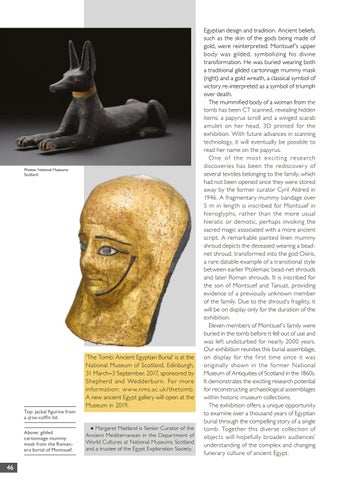
Top: jackal figurine from a qrsw-coffin lid. Above: gilded cartonnage mummy mask from the Romanera burial of Montsuef.
46
‘The Tomb: Ancient Egyptian Burial’ is at the National Museum of Scotland, Edinburgh, 31 March–3 September, 2017, sponsored by Shepherd and Wedderburn. For more information: w w w.nms.ac.uk /thetomb. A new ancient Egypt gallery will open at the Museum in 2019.
• Margaret Maitland is Senior Curator of the Ancient Mediterranean in the Department of World Cultures at National Museums Scotland and a trustee of the Egypt Exploration Society.
Egyptian design and tradition. Ancient beliefs, such as the skin of the gods being made of gold, were reinterpreted: Montsuef’s upper body was gilded, symbolizing his divine transformation. He was buried wearing both a traditional gilded cartonnage mummy mask (right) and a gold wreath, a classical symbol of victory re-interpreted as a symbol of triumph over death. The mummified body of a woman from the tomb has been CT scanned, revealing hidden items: a papyrus scroll and a winged scarab amulet on her head, 3D printed for the exhibition. With future advances in scanning technology, it will eventually be possible to read her name on the papyrus. One of the mos t exci ting r esear ch discoveries has been the rediscover y of several textiles belonging to the family, which had not been opened since they were stored away by the former curator Cyril Aldred in 1946. A fragmentary mummy bandage over 5 m in length is inscribed for Montsuef in hieroglyphs, rather than the more usual hieratic or demotic, perhaps invoking the sacred magic associated with a more ancient script. A remarkable painted linen mummy shroud depicts the deceased wearing a beadnet shroud, transformed into the god Osiris, a rare datable example of a transitional style between earlier Ptolemaic bead-net shrouds and later Roman shrouds. It is inscribed for the son of Montsuef and Tanuat, providing evidence of a previously unknown member of the family. Due to the shroud’s fragility, it will be on display only for the duration of the exhibition. Eleven members of Montsuef’s family were buried in the tomb before it fell out of use and was left undisturbed for nearly 2000 years. Our exhibition reunites this burial assemblage, on display for the first time since it was originally shown in the former National Museum of Antiquities of Scotland in the 1860s. It demonstrates the exciting research potential for reconstructing archaeological assemblages within historic museum collections. The exhibition offers a unique opportunity to examine over a thousand years of Egyptian burial through the compelling story of a single tomb. Together this diverse collection of objects will hopefully broaden audiences’ understanding of the complex and changing funerary culture of ancient Egypt.