Photos: National Museums Scotland
ONE THEBAN TOMB, ONE THOUSAND YEARS OF BURIAL
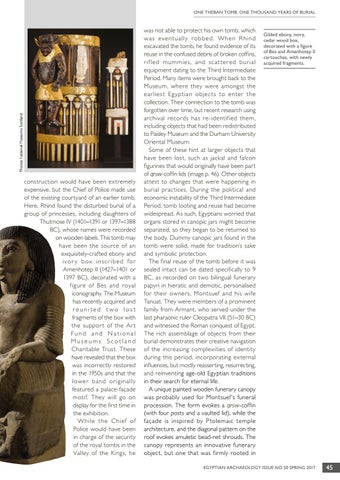
construction would have been extremely expensive, but the Chief of Police made use of the existing courtyard of an earlier tomb. Here, Rhind found the disturbed burial of a group of princesses, including daughters of Thutmose IV (1401–1391 or 1397–1388 BC), whose names were recorded on wooden labels. This tomb may have been the source of an exquisitely-crafted ebony and i vo r y b ox ins cr ib e d fo r Amenhotep II (1427–1401 or 1397 BC), decorated with a f igure of Bes and royal iconography. The Museum has recently acquired and reunited two lost fragments of the box with the suppor t of the Ar t Fund and National Museums Scotland Charitable Trust. These have revealed that the box was incorrectly restored in the 1950s and that the lower band or iginally featured a palace-façade motif. They will go on display for the first time in the exhibition. W hile the Chief of Police would have been in charge of the security of the royal tombs in the Valley of the Kings, he
was not able to protect his own tomb, which wa s eventually r obbed. W hen R hind excavated the tomb, he found evidence of its reuse in the confused debris of broken coffins, r if led mummies, and scat tered bur ial equipment dating to the Third Intermediate Period. Many items were brought back to the Museum, where they were amongst the earlies t Eg yptian objec ts to enter the collection. Their connection to the tomb was forgotten over time, but recent research using archival records has re-identif ied them, including objects that had been redistributed to Paisley Museum and the Durham University Oriental Museum. Some of these hint at larger objects that have been lost, such as jackal and falcon figurines that would originally have been part of qrsw-coffin lids (image p. 46). Other objects attest to changes that were happening in burial practices. During the political and economic instability of the Third Intermediate Period, tomb looting and reuse had become widespread. As such, Egyptians worried that organs stored in canopic jars might become separated, so they began to be returned to the body. Dummy canopic jars found in the tomb were solid, made for tradition’s sake and symbolic protection. The final reuse of the tomb before it was sealed intact can be dated specifically to 9 BC, as recorded on two bilingual funerary papyri in hieratic and demotic, personalised for their owners, Montsuef and his wife Tanuat. They were members of a prominent family from Armant, who served under the last pharaonic ruler Cleopatra VII (51–30 BC) and witnessed the Roman conquest of Egypt. The rich assemblage of objects from their burial demonstrates their creative navigation of the increasing complexities of identity during this period, incorporating external influences, but mostly reasserting, resurrecting, and reinventing age-old Egyptian traditions in their search for eternal life. A unique painted wooden funerary canopy was probably used for Montsuef ’s funeral procession. The form evokes a qrsw-coffin (with four posts and a vaulted lid), while the façade is inspired by P tolemaic temple architecture, and the diagonal pattern on the roof evokes amuletic bead-net shrouds. The canopy represents an innovative funerary object, but one that was firmly rooted in
Gilded ebony, ivory, cedar wood box, decorated with a figure of Bes and Amenhotep II cartouches, with newly acquired fragments.
EGYPTIAN ARCHAEOLOGY ISSUE NO 50 SPRING 2017
45