One Theban tomb, 1000 years of burial A new exhibition at the National Museum of Scotland in Edinburgh, ‘The Tomb: Ancient Egyptian Burial’, explores changing funerary practices through the story of one Theban tomb, used and reused for over 1000 years, before it became the first to be systematically excavated and recorded 160 years ago, as curator Margaret Maitland explains In the early 19th century, Europe’s race to uncover ancient Egyptian treasures often amounted to little better than tomb looting. With no archaeological recording, there was limited understanding of burial practices and how they changed over time. One man set out to attempt to change that and discovered an extraordinary group of funerary objects that are the focus of a new exhibition at the National Museum of Scotland. Alexander Henry Rhind (1833–1863) had studied Scottish history at the University of Edinburgh and excavated several sites in Scotland before becoming the first experienced archaeologist to work in Egypt. He sought an int ac t tomb, hoping to gain a bet ter understanding of Egyptian funerary customs from excavating a complete burial assemblage in context: One of my chief designs here is to discover, if possible, tombs that have never been disturbed, and in which the deposits remain in situ. It appears to me that facts of considerable interest and even importance might be evolved from a precise comparison.
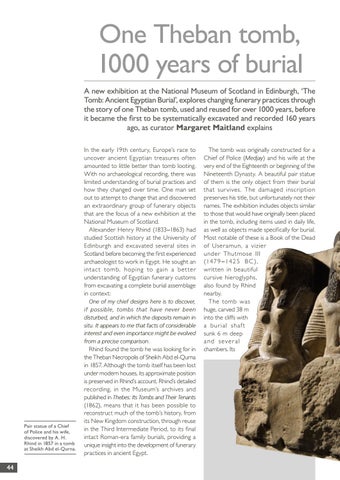
Pair statue of a Chief of Police and his wife, discovered by A. H. Rhind in 1857 in a tomb at Sheikh Abd el-Qurna.
44
Rhind found the tomb he was looking for in the Theban Necropolis of Sheikh Abd el-Qurna in 1857. Although the tomb itself has been lost under modern houses, its approximate position is preserved in Rhind’s account. Rhind’s detailed recording, in the Museum’s archives and published in Thebes: Its Tombs and Their Tenants (1862), means that it has been possible to reconstruct much of the tomb’s history, from its New Kingdom construction, through reuse in the Third Intermediate Period, to its final intact Roman-era family burials, providing a unique insight into the development of funerary practices in ancient Egypt.
The tomb was originally constructed for a Chief of Police (Medjay) and his wife at the very end of the Eighteenth or beginning of the Nineteenth Dynasty. A beautiful pair statue of them is the only object from their burial that sur vives. The damaged inscription preserves his title, but unfortunately not their names. The exhibition includes objects similar to those that would have originally been placed in the tomb, including items used in daily life, as well as objects made specifically for burial. Most notable of these is a Book of the Dead of Useramun, a vizier under Thutmose III (14 7 9 – 142 5 B C ) , written in beautiful cursive hieroglyphs, also found by Rhind nearby. The tomb was huge, carved 38 m into the cliffs with a bur ial shaf t sunk 6 m deep and sever al chambers. Its