KING SAHURE IN ELKAB
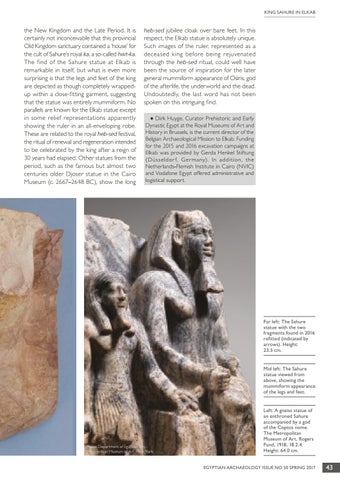
the New Kingdom and the Late Period. It is certainly not inconceivable that this provincial Old Kingdom sanctuary contained a ‘house’ for the cult of Sahure’s royal ka, a so-called hwt-ka. The find of the Sahure statue at Elkab is remarkable in itself, but what is even more surprising is that the legs and feet of the king are depicted as though completely wrappedup within a close-fitting garment, suggesting that the statue was entirely mummiform. No parallels are known for the Elkab statue except in some relief representations apparently showing the ruler in an all-enveloping robe. These are related to the royal heb-sed festival, the ritual of renewal and regeneration intended to be celebrated by the king after a reign of 30 years had elapsed. Other statues from the period, such as the famous but almost two centuries older Djoser statue in the Cairo Museum (c. 2667–2648 BC), show the long
heb-sed jubilee cloak over bare feet. In this
respect, the Elkab statue is absolutely unique. Such images of the ruler, represented as a deceased king before being rejuvenated through the heb-sed ritual, could well have been the source of inspiration for the later general mummiform appearance of Osiris, god of the afterlife, the underworld and the dead. Undoubtedly, the last word has not been spoken on this intriguing find.
• Dirk Huyge, Curator Prehistoric and Early Dynastic Egypt at the Royal Museums of Art and History in Brussels, is the current director of the Belgian Archaeological Mission to Elkab. Funding for the 2015 and 2016 excavation campaigns at Elkab was provided by Gerda Henkel Stiftung (Düsseldor f, Ger many). In addition, the Netherlands-Flemish Institute in Cairo (NVIC) and Vodafone Egypt offered administrative and logistical support.
Far left: The Sahure statue with the two fragments found in 2016 refitted (indicated by arrows). Height: 23.5 cm.
Mid left: The Sahure statue viewed from above, showing the mummiform appearance of the legs and feet.
Photo: Department of Egyptian Art, Metropolitan Museum of Art, New York.
Left: A gneiss statue of an enthroned Sahure accompanied by a god of the Coptos nome. The Metropolitan Museum of Art, Rogers Fund, 1918, 18.2.4. Height: 64.0 cm. EGYPTIAN ARCHAEOLOGY ISSUE NO 50 SPRING 2017
43