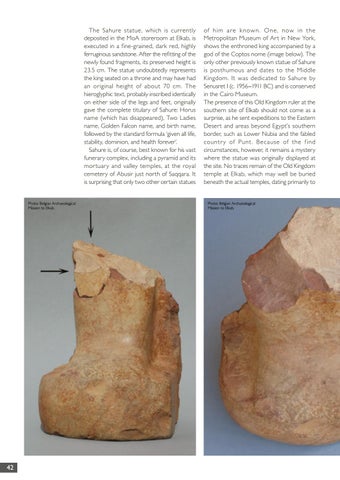
The Sahure statue, which is currently deposited in the MoA storeroom at Elkab, is executed in a fine-grained, dark red, highly ferruginous sandstone. After the refitting of the newly found fragments, its preserved height is 23.5 cm. The statue undoubtedly represents the king seated on a throne and may have had an original height of about 70 cm. The hieroglyphic text, probably inscribed identically on either side of the legs and feet, originally gave the complete titulary of Sahure: Horus name (which has disappeared), Two Ladies name, Golden Falcon name, and birth name, followed by the standard formula ‘given all life, stability, dominion, and health forever’. Sahure is, of course, best known for his vast funerary complex, including a pyramid and its mor tuary and valley temples, at the royal cemetery of Abusir just north of Saqqara. It is surprising that only two other certain statues Photo: Belgian Archaeological Mission to Elkab.
42
of him ar e k nown. One , now in the Metropolitan Museum of Art in New York, shows the enthroned king accompanied by a god of the Coptos nome (image below). The only other previously known statue of Sahure is posthumous and dates to the Middle Kingdom. It was dedicated to Sahure by Senusret I (c. 1956–1911 BC) and is conserved in the Cairo Museum. The presence of this Old Kingdom ruler at the southern site of Elkab should not come as a surprise, as he sent expeditions to the Eastern Desert and areas beyond Egypt’s southern border, such as Lower Nubia and the fabled countr y of Punt. Because of the f ind circumstances, however, it remains a mystery where the statue was originally displayed at the site. No traces remain of the Old Kingdom temple at Elkab, which may well be buried beneath the actual temples, dating primarily to Photo: Belgian Archaeological Mission to Elkab.