King Sahure in Elkab The finding of an important fragment of a unique Old Kingdom royal statue at the southern Egyptian site of Elkab raises several new research questions. Dirk Huyge reports on the 2015 chance discovery and the subsequent 2016 attempt to elucidate its significance. period. Numerous fragments of human and animal terracotta figurines were also found. Among the more remarkable finds are a number of fragments of Greek impor ted ceramics with a glossy black coating, probably dating back to the 4th century BC. The latter are a novelty to Elkab.
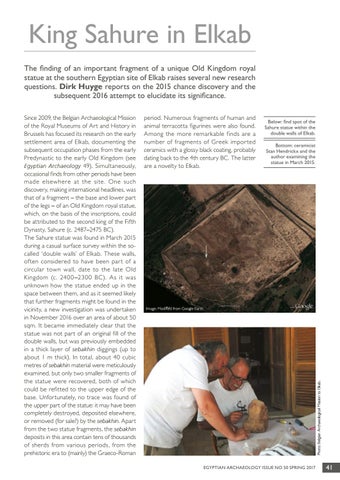
Below: find spot of the Sahure statue within the double walls of Elkab. Bottom: ceramicist Stan Hendrickx and the author examining the statue in March 2015.
Image: Modified from Google Earth.
Photo: Belgian Archaeological Mission to Elkab.
Since 2009, the Belgian Archaeological Mission of the Royal Museums of Art and History in Brussels has focused its research on the early settlement area of Elkab, documenting the subsequent occupation phases from the early Predynastic to the early Old Kingdom (see Egyptian Archaeology 49). Simultaneously, occasional finds from other periods have been made elsewhere at the site. One such discovery, making international headlines, was that of a fragment – the base and lower part of the legs – of an Old Kingdom royal statue, which, on the basis of the inscriptions, could be attributed to the second king of the Fifth Dynasty, Sahure (c. 2487–2475 BC). The Sahure statue was found in March 2015 during a casual surface survey within the socalled ‘double walls’ of Elkab. These walls, often considered to have been par t of a circular town wall, date to the late Old Kingdom (c. 2400 –2300 BC). As it was unknown how the statue ended up in the space between them, and as it seemed likely that further fragments might be found in the vicinity, a new investigation was undertaken in November 2016 over an area of about 50 sqm. It became immediately clear that the statue was not part of an original fill of the double walls, but was previously embedded in a thick layer of sebakhin diggings (up to about 1 m thick). In total, about 40 cubic metres of sebakhin material were meticulously examined, but only two smaller fragments of the statue were recovered, both of which could be refitted to the upper edge of the base. Unfortunately, no trace was found of the upper part of the statue: it may have been completely destroyed, deposited elsewhere, or removed (for sale?) by the sebakhin. Apart from the two statue fragments, the sebakhin deposits in this area contain tens of thousands of sherds from various periods, from the prehistoric era to (mainly) the Graeco-Roman
EGYPTIAN ARCHAEOLOGY ISSUE NO 50 SPRING 2017
41