CATCHING UP WITH THE COLOSSI: THE 2015-16 SEASONS
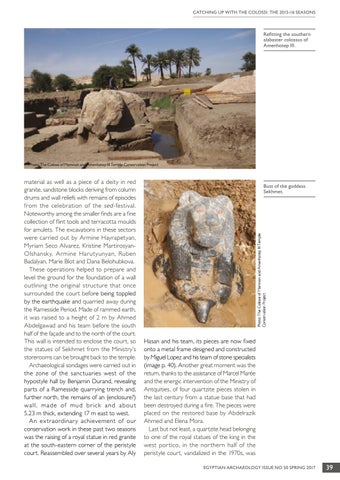
Refitting the southern alabaster colossus of Amenhotep III.
Photo: The Colossi of Memnon and Amenhotep III Temple Conservation Project
Bust of the goddess Sekhmet.
Photo: The Colossi of Memnon and Amenhotep III Temple Conservation Project
material as well as a piece of a deity in red granite, sandstone blocks deriving from column drums and wall reliefs with remains of episodes from the celebration of the sed -festival. Noteworthy among the smaller finds are a fine collection of flint tools and terracotta moulds for amulets. The excavations in these sectors were carried out by Armine Hayrapetyan, Myriam Seco Alvarez, Kristine MartirosyanOlshansky, Armine Harutyunyan, Ruben Badalyan, Marie Blot and Dana Belohubkova. These operations helped to prepare and level the ground for the foundation of a wall outlining the original structure that once surrounded the court before being toppled by the earthquake and quarried away during the Ramesside Period. Made of rammed earth, it was raised to a height of 2 m by Ahmed Abdelgawad and his team before the south half of the façade and to the north of the court. This wall is intended to enclose the court, so the statues of Sekhmet from the Ministry’s storerooms can be brought back to the temple. Archaeological sondages were carried out in the zone of the sanctuaries west of the hypostyle hall by Benjamin Durand, revealing parts of a Ramesside quarrying trench and, further north, the remains of an (enclosure?) w all, made of mud br ick a nd a bou t 5.23 m thick, extending 17 m east to west. An ex traordinar y achievement of our conservation work in these past two seasons was the raising of a royal statue in red granite at the south-eastern corner of the peristyle court. Reassembled over several years by Aly
Hasan and his team, its pieces are now fixed onto a metal frame designed and constructed by Miguel Lopez and his team of stone specialists (image p. 40). Another great moment was the return, thanks to the assistance of Marcel Marée and the energic intervention of the Ministry of Antquities, of four quartzite pieces stolen in the last century from a statue base that had been destroyed during a fire. The pieces were placed on the restored base by Abdelrazik Ahmed and Elena Mora. Last but not least, a quartzite head belonging to one of the royal statues of the king in the west por tico, in the nor thern half of the peristyle court, vandalized in the 1970s, was EGYPTIAN ARCHAEOLOGY ISSUE NO 50 SPRING 2017
39