Bas-relief of a Nile god with the sema tawy.
38
lying in fragments at the beginning of our project. In Egyptian Archaeology 44, we reported on the raising of the lower part, followed by parts of the body and the chest of the Northern Colossus, onto which the head was fixed in spring 2014. A year later, in spring 2015, the body of the South Colossus could be raised thanks to the skill of the stone specialists, directed by Miguel Lopez, working with rais Mohamed Ali Ghassab and his team. Restoration and the joining of new pieces, done by Elena Mora Ruedas, Mohamed Abdel-Baset ‘Baree’ and their assistants, continued on these monument all through the spring and autumn seasons. More pieces were added to the bodies and bases of the colossi. A protective brick wall indicating the location and width of the Second Pylon was built by Nairy Hampikian at the edge of the modern road that cuts through the southern end of the pylon. Until the area is secured and the monuments can be opened to visitors, the wall, complete with explanatory panels, offers a panoramic view on the two seated colossi from the road. Archaeological investigations were pursued around the Third Pylon under the direction of Carmen Lopez Roa, discovering a two-stepped brick terrace to the east of the south wing of the Pylon. More pieces of the southern alabaster colossus of Amenhotep III were recovered in this area, along with pieces detached form the black granite blocks that once formed the plinths of the colossi. The chest of the southern colossus appears to have been constructed using an ingenious assembly technique, slotting individually hewn pieces into the core of alabaster. The head was carved from the same monolith as the
Photo: The Colossi of Memnon and Amenhotep III Temple Conservation Project
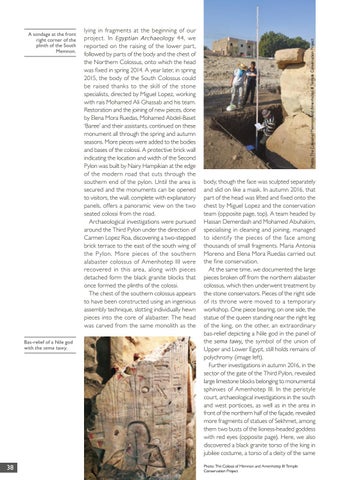
A sondage at the front right corner of the plinth of the South Memnon.
body, though the face was sculpted separately and slid on like a mask. In autumn 2016, that part of the head was lifted and fixed onto the chest by Miguel Lopez and the conservation team (opposite page, top). A team headed by Hassan Demerdash and Mohamed Abuhakim, specialising in cleaning and joining, managed to identify the pieces of the face among thousands of small fragments. Maria Antonia Moreno and Elena Mora Ruedas carried out the fine conservation. At the same time, we documented the large pieces broken off from the northern alabaster colossus, which then underwent treatment by the stone conservators. Pieces of the right side of its throne were moved to a temporary workshop. One piece bearing, on one side, the statue of the queen standing near the right leg of the king, on the other, an extraordinary bas-relief depicting a Nile god in the panel of the sema tawy, the symbol of the union of Upper and Lower Egypt, still holds remains of polychromy (image left). Further investigations in autumn 2016, in the sector of the gate of the Third Pylon, revealed large limestone blocks belonging to monumental sphinxes of Amenhotep III. In the peristyle court, archaeological investigations in the south and west porticoes, as well as in the area in front of the northern half of the façade, revealed more fragments of statues of Sekhmet, among them two busts of the lioness-headed goddess with red eyes (opposite page). Here, we also discovered a black granite torso of the king in jubilee costume, a torso of a deity of the same Photo: The Colossi of Memnon and Amenhotep III Temple Conservation Project