DIGGING DIARY 2016–17
rows of Amenhotep IV Karnak talatat blocks in the initial stages of a programme designed to record all 50,000 blocks and fragments in the blockyard. Egyptologist/artist K. Vertés continued his facsimile pencilling and digital inking of the Tetrarchic Roman frescoes in the Imperial Cult Chamber on the E and S walls. Luxor Temple conservator H. Kariya conducted her annual condition survey, maintenance and treatment of the blockyard material as well as consolidating a group of fragments that had been recovered during the USAID-funded Luxor Temple dewatering programme in the years before 2006. http://oi.uchicago.edu/research/ projects/epi/
Thebes West (Deir el-Bahari): The
Polish-Egyptian conservation effort under field director Zbigniew E. Szafranski (PCMA), coupled with documentation and digging, continued in the royal cult complex on the upper terrace of the Temple of Hatshepsut at Deir el-Bahari. A support-ballast limestone construction was unearthed in excavations conducted by the outer face of the S wall of the Chapel of Hatshepsut. This appears to be a unique example of building construction invented in the reign of the queen. Two Coptic papyri were found between blocks of the S wall of the Chapel; the documents were
we have started with a new reconstruction. www.templeofhatshepsut.uw.edu.pl/ en/
Thebes (Valley of the Kings): During the Nov 2016 to Feb 2017 season, the Kings Valley Project (Univ of Basel) under field directors Susanne Bickel and Elina PaulinGrothe, focused on the analysis of the large amount of fragmented burial goods retrieved from KV 40 and KV 64. Among the most rewarding convolutes are the pottery jars with inscriptions, naming princesses, princes and other members of the royal entourage from the time of Amenhotep III; textiles as well as coffin and cartonnage fragments from both the 18th Dyn and the period of reuse of the tomb in the 22nd Dyn. All pieces have to be cleaned and restored before analysis due to the impact of fire set by robbers. Anthropological analyses are being pursued and mummification techniques observed. KV 37 was accessed for the first time since the survey of the Theban Mapping Project in 1980 and a group of storage jars was found inside. The survey of the area and the reconstruction of the original topography and levels of use of the side valley leading to the tomb of Thutmose III are being expanded and site protection measures applied. The project also continues the study
fragments mainly from the destroyed doorway were recovered. Conservator H. Kariya consolidated the fractured limestone fragments in preparation for photography and drawing. Senior epigrapher J. B. McClain continued the first collation of the facsimile drawings of the portico façade reliefs done by senior epigraphic artists M. De Jong and S. Osgood, while R. Johnson continued the second collation of the drawings. http:// oi.uchicago.edu/research/projects/epi/
Medinet Habu: The epigraphic team
in the small Amun temple of Hatshepsut and Thutmose III under the supervision of J. B. McClain (OI) continued work on the drawings for Medinet Habu XI and XII between Oct 2016 and Apr 2017, while T. Di Cerbo and R. Jasnow continued their digital documentation of Coptic graffiti in the N Ptolemaic annex. Epigrapher J. Kimpton, assisted by A. Helmholz, continued the cataloguing of blocks and fragments of the destroyed Medinet Habu W High Gate, while artist K. Alberts continued the facsimile drawing of selected fragments and groups. Photographers Y. Kobylecky, H. McDonald and O. Murray all worked on the systematic documentation of the blocks, fragments and W area for photogrammetric mapping. Senior conservator L. Hassan
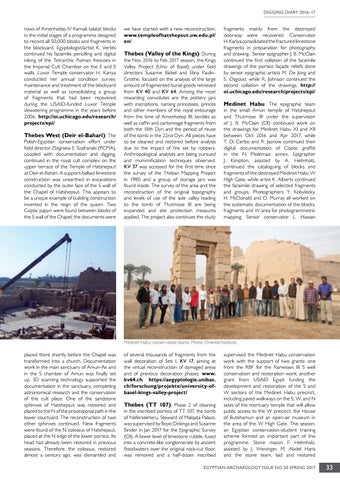
Medinet Habu: conservation teams. Photo: Oriental Institute.
placed there shortly before the Chapel was transformed into a church. Documentation work in the main sanctuary of Amun-Re and in the S chamber of Amun was finally set up. 3D scanning technology supported the documentation in the sanctuary, completing astronomical research and the conservation of this cult place. One of the sandstone sphinxes of Hatshepsut was restored and placed to the N of the processional path in the lower courtyard. The reconstruction of two other sphinxes continued. New fragments were found of the N colossus of Hatshepsut, placed at the N edge of the lower portico. Its head had already been restored in previous seasons. Therefore, the colossus, restored almost a century ago, was dismantled and
of several thousands of fragments from the wall decoration of Seti I, KV 17, aiming at the virtual reconstruction of damaged areas and of previous decoration phases. www. kv64.ch; https://aegyptologie.unibas. ch/forschung/projekte/university-ofbasel-kings-valley-project/
Thebes (TT 107): Phase 2 of cleaning in the inscribed portico of TT 107, the tomb of Nefersekheru, Steward of Malqata Palace, was supervised by Boyo Ockinga and Susanne Binder in Jan 2017 for the Epigraphic Survey (OI). A lower level of limestone rubble, fused into a concrete-like conglomerate by ancient floodwaters over the original rock-cut floor, was removed and a half-dozen inscribed
supervised the Medinet Habu conservation work with the support of two grants: one from the RBF for the Ramesses III S well conservation and restoration work; another grant from USAID Egypt funding the development and restoration of the S and W sectors of the Medinet Habu precinct, including paved walkways on the S, W, and N sides of the mortuary temple that will allow public access to the W precinct, the House of Butehamun and an open-air museum in the area of the W High Gate. This season, an Egyptian conservation-student training scheme formed an important part of this programme. Stone mason F. Helmholz, assisted by J. Weninger, M. Abdel Haris and the stone team, laid and restored
EGYPTIAN ARCHAEOLOGY ISSUE NO 50 SPRING 2017
33