Tim Ralph (Macquarie Univ) also revealed the location of the flood plain immediately to the N of this part of the settlement. Intramural excavations have also been completed this season. In the vicinity of the Hathor and Isis temples, well-stratified 4th and 5th Dyn administrative and domestic contexts have been discovered, sealed under the foundation layer of an early MK enclosure wall. On the S and E sides of the Isis temple, under the foundation of another early MK building (very first phase of this sanctuary?), remains from Nagada IIC-D have been further excavated, leading to the discovery of several stratified phases and an early installation made with large limestone boulders, confirming the domestic and artisanal function (brewery) of those contexts. This is the oldest evidence of occupation discovered so far at Dendara. w w w.ifao.egnet .net /a rcheologie / dendara/
Dendera: The IFAO team directed by Pierre Zignani continued work at Dendera in collaboration with Macquarie Univ (Yann Tristant) and the OI (Grégory Marouard) in Nov/Dec 2016. The season was devoted to the architectural studies of cultic buildings (Roman mammisi, technology of the ashlar stonework), the excavation of the large Pharaonic cemetery and the settlement.
geomorphological survey aims to reconstruct the ancient landscape of Dendera and the developments of the Nile River in the past: w w w.ifao.egnet .net /a rcheologie / dendara/
Deir el-Ballas: At the request of Mr. Mustafa Waziri and the Qena Inspectorate of Antiquities, in response to damage at the site from looting and the expansion of the surrounding modern town and cemetery, new work was conducted at the SIP-Early 18th Dyn site of Deir el-Ballas by the Ancient Egyptian Heritage and Archaeology Fund under the direction of Peter Lacovara in Jan 2017. Our goals were to survey, map and photograph to assess the current condition of the site, the perimeter of the antiquities area, and possible ways to protect and restore the standing structures. We concentrated this season on the ‘South Palace’, which had suffered from looters emptying out some of the casemate foundations and digging holes in the façade of the E wall of the platform, resulting in the collapse of significant parts of the brick facing. While the areas of the Workmen’s Village and associated chapels have been entirely destroyed, many other parts of the settlement have so far been preserved. The ‘North Palace’ is being encroached upon by the spread of the
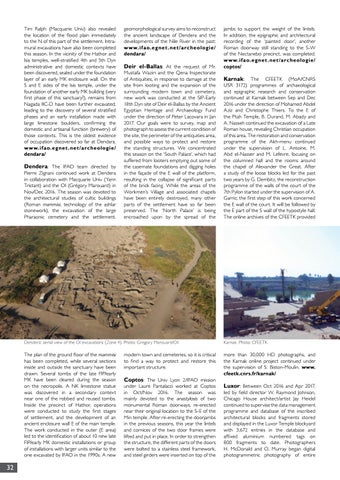
Dendera: aerial view of the OI excavations (Zone 4). Photo: Gregory Marouard/OI.
The plan of the ground floor of the mammisi has been completed, while several sections inside and outside the sanctuary have been drawn. Several tombs of the late FIP/early MK have been cleared during the season on the necropolis. A NK limestone statue was discovered in a secondary context near one of the robbed and reused tombs. Inside the precinct of Hathor, operations were conducted to study the first stages of settlement, and the development of an ancient enclosure wall E of the main temple. The work conducted in the outer (E area) led to the identification of about 10 new late FIP/early MK domestic installations or group of installations with larger units similar to the one excavated by IFAO in the 1990s. A new
32
modern town and cemeteries, so it is critical to find a way to protect and restore this important structure.
Coptos: The Univ Lyon 2/IFAO mission under Laure Pantalacci worked at Coptos in Oct/Nov 2016. The season was mainly devoted to the anastylosis of two monumental Roman doorways, re-erected near their original location to the S-E of the Min temple. After re-erecting the doorjambs in the previous seasons, this year the lintels and cornices of the two door frames were lifted and put in place. In order to strengthen the structure, the different parts of the doors were bolted to a stainless steel framework, and steel girders were inserted on top of the
jambs to support the weight of the lintels. In addition, the epigraphic and architectural recording of the ‘painted door’, another Roman doorway still standing to the S-W of the Nectanebo precinct, was completed. w w w.ifao.egnet .net /a rcheologie / coptos/
Karnak:
The CFEETK (MoA/CNRS USR 3172) programmes of archaeological and epigraphic research and conservation continued at Karnak between Sep and Dec 2016 under the direction of Mohamed Abdel Aziz and Christophe Thiers. To the E of the Ptah Temple, B. Durand, M. Abady and A. Nasseh continued the excavation of a Late Roman house, revealing Christian occupation of this area. The restoration and conservation programme of the Akh-menu continued under the supervision of L. Antoine, M. Abd el-Nasser and M. Lefevre, focusing on the columned hall and the rooms around the chapel of Alexander the Great. After a study of the loose blocks led for the past two years by G. Dembitz, the reconstruction programme of the walls of the court of the 7th Pylon started under the supervision of A. Garric; the first step of this work concerned the E wall of the court. It will be followed by the E part of the S wall of the hypostyle hall. The online archives of the CFEETK provided
Karnak. Photo: CFEETK.
more than 30,000 HD photographs, and the Karnak online project continued under the supervision of S. Biston-Moulin. www. cfeetk.cnrs.fr/karnak/
Luxor: Between Oct 2016 and Apr 2017,
led by field director W. Raymond Johnson, Chicago House architect/artist Jay Heidel continued to supervise the data management programme and database of the inscribed architectural blocks and fragments stored and displayed in the Luxor Temple blockyard with 3,672 entries in the database and affixed aluminium numbered tags on 800 fragments to date. Photographers H. McDonald and O. Murray began digital photogrammetric photography of entire