Photo: Piotr Witkowski
Photo: Marta Kaczanowicz
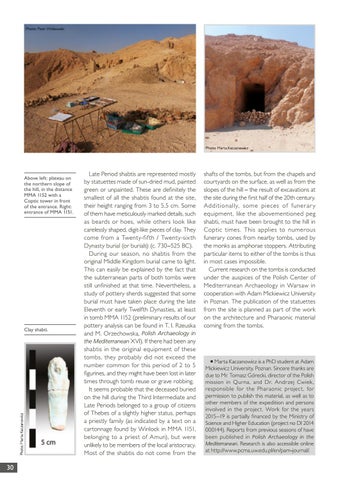
Above left: plateau on the northern slope of the hill, in the distance MMA 1152 with a Coptic tower in front of the entrance. Right: entrance of MMA 1151.
Photo: Marta Kaczanowicz
Clay shabti.
30
Late Period shabtis are represented mostly by statuettes made of sun-dried mud, painted green or unpainted. These are definitely the smallest of all the shabtis found at the site, their height ranging from 3 to 5.5 cm. Some of them have meticulously marked details, such as beards or hoes, while others look like carelessly shaped, digit-like pieces of clay. They come from a Twenty-fifth / Twenty-sixth Dynasty burial (or burials) (c. 730–525 BC). During our season, no shabtis from the original Middle Kingdom burial came to light. This can easily be explained by the fact that the subterranean parts of both tombs were still unfinished at that time. Nevertheless, a study of pottery sherds suggested that some burial must have taken place during the late Eleventh or early Twelfth Dynasties, at least in tomb MMA 1152 (preliminary results of our pottery analysis can be found in T. I. Rzeuska and M. Orzechowska, Polish Archaeology in the Mediterranean XVI). If there had been any shabtis in the original equipment of these tombs, they probably did not exceed the number common for this period of 2 to 5 figurines, and they might have been lost in later times through tomb reuse or grave robbing. It seems probable that the deceased buried on the hill during the Third Intermediate and Late Periods belonged to a group of citizens of Thebes of a slightly higher status, perhaps a priestly family (as indicated by a text on a cartonnage found by Winlock in MMA 1151, belonging to a priest of Amun), but were unlikely to be members of the local aristocracy. Most of the shabtis do not come from the
shafts of the tombs, but from the chapels and courtyards on the surface, as well as from the slopes of the hill – the result of excavations at the site during the first half of the 20th century. Additionally, some pieces of funer ar y equipment, like the abovementioned peg shabti, must have been brought to the hill in Coptic times. This applies to numerous funerary cones from nearby tombs, used by the monks as amphorae stoppers. Attributing particular items to either of the tombs is thus in most cases impossible. Current research on the tombs is conducted under the auspices of the Polish Center of Mediterranean Archaeology in Warsaw in cooperation with Adam Mickiewicz University in Poznan. The publication of the statuettes from the site is planned as part of the work on the architecture and Pharaonic material coming from the tombs.
• Marta Kaczanowicz is a PhD student at Adam Mickiewicz University, Poznan. Sincere thanks are due to Mr. Tomasz Górecki, director of the Polish mission in Qurna, and Dr. Andrzej Cwiek, responsible for the Pharaonic project, for permission to publish this material, as well as to other members of the expedition and persons involved in the project. Work for the years 2015–19 is partially financed by the Ministry of Science and Higher Education (project no DI 2014 000144). Reports from previous seasons of have been published in Polish Archaeology in the Mediterranean. Research is also accessible online at http://www.pcma.uw.edu.pl/en/pam-journal/.