SHABTIS FROM TOMBS MMA 1151 AND 1152 IN WESTERN THEBES
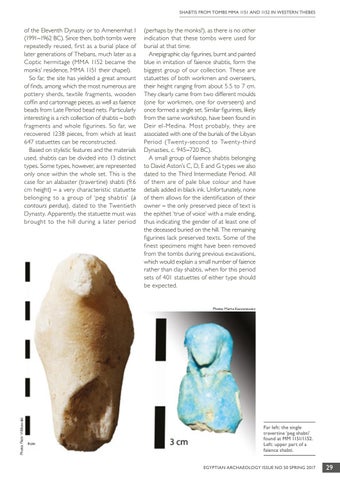
of the Eleventh Dynasty or to Amenemhat I (1991–1962 BC). Since then, both tombs were repeatedly reused, first as a burial place of later generations of Thebans, much later as a Coptic hermitage (MMA 1152 became the monks’ residence, MMA 1151 their chapel). So far, the site has yielded a great amount of finds, among which the most numerous are pottery sherds, textile fragments, wooden coffin and cartonnage pieces, as well as faience beads from Late Period bead nets. Particularly interesting is a rich collection of shabtis – both fragments and whole figurines. So far, we recovered 1238 pieces, from which at least 647 statuettes can be reconstructed. Based on stylistic features and the materials used, shabtis can be divided into 13 distinct types. Some types, however, are represented only once within the whole set. This is the case for an alabaster (travertine) shabti (9.6 cm height) – a very characteristic statuette belonging to a group of ‘peg shabtis’ (à contours perdus), dated to the Twentieth Dynasty. Apparently, the statuette must was brought to the hill during a later period
(perhaps by the monks?), as there is no other indication that these tombs were used for burial at that time. Anepigraphic clay figurines, burnt and painted blue in imitation of faience shabtis, form the biggest group of our collection. These are statuettes of both workmen and overseers, their height ranging from about 5.5 to 7 cm. They clearly came from two different moulds (one for workmen, one for overseers) and once formed a single set. Similar figurines, likely from the same workshop, have been found in Deir el-Medina. Most probably, they are associated with one of the burials of the Libyan Period (Twenty-second to Twenty-third Dynasties, c. 945–720 BC). A small group of faience shabtis belonging to David Aston’s C, D, E and G types we also dated to the Third Intermediate Period. All of them are of pale blue colour and have details added in black ink. Unfortunately, none of them allows for the identification of their owner – the only preserved piece of text is the epithet ‘true of voice’ with a male ending, thus indicating the gender of at least one of the deceased buried on the hill. The remaining figurines lack preserved texts. Some of the finest specimens might have been removed from the tombs during previous excavations, which would explain a small number of faience rather than clay shabtis, when for this period sets of 401 statuettes of either type should be expected.
Photo: Piotr Witkowski
Photo: Marta Kaczanowicz
Far left: the single travertine ‘peg shabti’ found at MM 1151/1152. Left: upper part of a faience shabti. EGYPTIAN ARCHAEOLOGY ISSUE NO 50 SPRING 2017
29