Photo: Marta Kaczanowicz
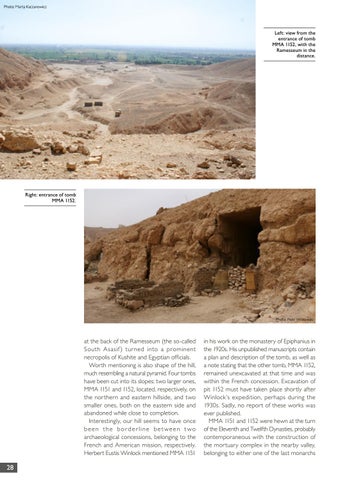
Left: view from the entrance of tomb MMA 1152, with the Ramesseum in the distance.
Right: entrance of tomb MMA 1152.
Photo: Piotr Witkowski
at the back of the Ramesseum (the so-called South Asasif ) turned into a prominent necropolis of Kushite and Egyptian officials. Worth mentioning is also shape of the hill, much resembling a natural pyramid. Four tombs have been cut into its slopes: two larger ones, MMA 1151 and 1152, located, respectively, on the northern and eastern hillside, and two smaller ones, both on the eastern side and abandoned while close to completion. Interestingly, our hill seems to have once been the border line bet ween t wo archaeological concessions, belonging to the French and American mission, respectively. Herbert Eustis Winlock mentioned MMA 1151
28
in his work on the monastery of Epiphanius in the 1920s. His unpublished manuscripts contain a plan and description of the tomb, as well as a note stating that the other tomb, MMA 1152, remained unexcavated at that time and was within the French concession. Excavation of pit 1152 must have taken place shortly after Winlock’s expedition, perhaps during the 1930s. Sadly, no report of these works was ever published. MMA 1151 and 1152 were hewn at the turn of the Eleventh and Twelfth Dynasties, probably contemporaneous with the construction of the mortuary complex in the nearby valley, belonging to either one of the last monarchs