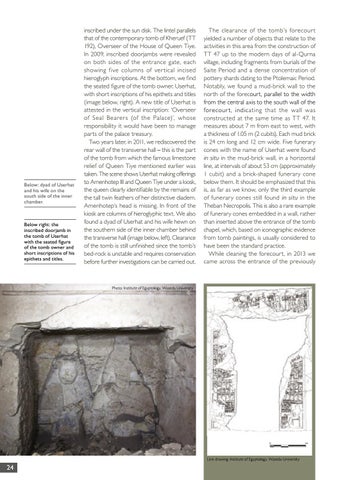
Below: dyad of Userhat and his wife on the south side of the inner chamber.
Below right: the inscribed doorjamb in the tomb of Userhat with the seated figure of the tomb owner and short inscriptions of his epithets and titles.
inscribed under the sun disk. The lintel parallels that of the contemporary tomb of Kheruef (TT 192), Overseer of the House of Queen Tiye. In 2009, inscribed doorjambs were revealed on both sides of the entrance gate, each showing f ive columns of ver tical incised hieroglyph inscriptions. At the bottom, we find the seated figure of the tomb owner, Userhat, with short inscriptions of his epithets and titles (image below, right). A new title of Userhat is attested in the vertical inscription: ‘Overseer of Seal Bearers (of the Palace)’, whose responsibility it would have been to manage parts of the palace treasury. Two years later, in 2011, we rediscovered the rear wall of the transverse hall – this is the part of the tomb from which the famous limestone relief of Queen Tiye mentioned earlier was taken. The scene shows Userhat making offerings to Amenhotep III and Queen Tiye under a kiosk, the queen clearly identifiable by the remains of the tall twin feathers of her distinctive diadem. Amenhotep‘s head is missing. In front of the kiosk are columns of hieroglyphic text. We also found a dyad of Userhat and his wife hewn on the southern side of the inner chamber behind the transverse hall (image below, left). Clearance of the tomb is still unfinished since the tomb’s bed-rock is unstable and requires conservation before further investigations can be carried out.
The clearance of the tomb’s forecour t yielded a number of objects that relate to the activities in this area from the construction of TT 47 up to the modern days of al-Qurna village, including fragments from burials of the Saite Period and a dense concentration of pottery shards dating to the Ptolemaic Period. Notably, we found a mud-brick wall to the north of the forecourt, parallel to the width from the central axis to the south wall of the forecour t, indicating that the wall was constructed at the same time as TT 47. It measures about 7 m from east to west, with a thickness of 1.05 m (2 cubits). Each mud brick is 24 cm long and 12 cm wide. Five funerary cones with the name of Userhat were found in situ in the mud-brick wall, in a horizontal line, at intervals of about 53 cm (approximately 1 cubit) and a brick-shaped funerary cone below them. It should be emphasized that this is, as far as we know, only the third example of funerary cones still found in situ in the Theban Necropolis. This is also a rare example of funerary cones embedded in a wall, rather than inserted above the entrance of the tomb chapel, which, based on iconographic evidence from tomb paintings, is usually considered to have been the standard practice. While cleaning the forecourt, in 2013 we came across the entrance of the previously
Photo: Institute of Egyptology, Waseda University
Line drawing: Institute of Egyptology, Waseda University
24