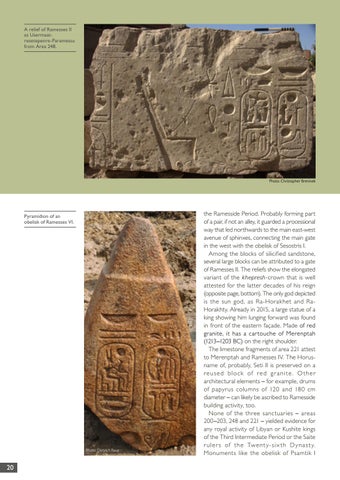
A relief of Ramesses II as Usermaatresetepenre-Paramessu from Area 248.
Photo: Christopher Breninek
Pyramidion of an obelisk of Ramesses VI.
Photo: Dietrich Raue
20
the Ramesside Period. Probably forming part of a pair, if not an alley, it guarded a processional way that led northwards to the main east-west avenue of sphinxes, connecting the main gate in the west with the obelisk of Sesostris I. Among the blocks of silicified sandstone, several large blocks can be attributed to a gate of Ramesses II. The reliefs show the elongated variant of the khepresh -crown that is well attested for the latter decades of his reign (opposite page, bottom). The only god depicted is the sun god, as Ra-Horakhet and RaHorakhty. Already in 2015, a large statue of a king showing him lunging forward was found in front of the eastern façade. Made of red granite, it has a car touche of Merenptah (1213–1203 BC) on the right shoulder. The limestone fragments of area 221 attest to Merenptah and Ramesses IV. The Horusname of, probably, Seti II is preserved on a r e u s e d b lo ck of r e d g r a n i te . O t h e r architectural elements – for example, drums of papyrus columns of 120 and 180 cm diameter – can likely be ascribed to Ramesside building activity, too. None of the three sanctuaries – areas 200–203, 248 and 221 – yielded evidence for any royal activity of Libyan or Kushite kings of the Third Intermediate Period or the Saite r ule r s of t he Twe nt y-six t h D y na s t y. Monuments like the obelisk of Psamtik I