MATARIYA 2016: RAMESSIDE DYNASTIES AT HELIOPOLIS
Photo: Mariana Jung
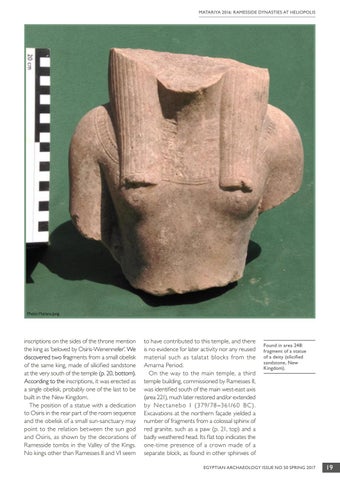
inscriptions on the sides of the throne mention the king as ‘beloved by Osiris-Wenennefer’. We discovered two fragments from a small obelisk of the same king, made of silicified sandstone at the very south of the temple (p. 20, bottom). According to the inscriptions, it was erected as a single obelisk, probably one of the last to be built in the New Kingdom. The position of a statue with a dedication to Osiris in the rear part of the room sequence and the obelisk of a small sun-sanctuary may point to the relation between the sun god and Osiris, as shown by the decorations of Ramesside tombs in the Valley of the Kings. No kings other than Ramesses II and VI seem
to have contributed to this temple, and there is no evidence for later activity nor any reused material such as talatat blocks from the Amarna Period. On the way to the main temple, a third temple building, commissioned by Ramesses II, was identified south of the main west-east axis (area 221), much later restored and/or extended by Nec tanebo I (379/ 78 –361/60 BC). Excavations at the northern façade yielded a number of fragments from a colossal sphinx of red granite, such as a paw (p. 21, top) and a badly weathered head. Its flat top indicates the one-time presence of a crown made of a separate block, as found in other sphinxes of
Found in area 248: fragment of a statue of a deity (silicified sandstone, New Kingdom).
EGYPTIAN ARCHAEOLOGY ISSUE NO 50 SPRING 2017
19