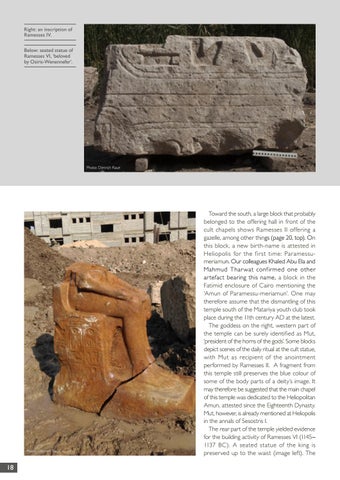
Right: an inscription of Ramesses IV. Below: seated statue of Ramesses VI, ‘beloved by Osiris-Wenennefer’.
Photo: Dietrich Raue
Photo: Dietrich Raue
18
Toward the south, a large block that probably belonged to the offering hall in front of the cult chapels shows Ramesses II offering a gazelle, among other things (page 20, top). On this block, a new birth-name is attested in Heliopolis for the first time: Paramessumeriamun. Our colleagues Khaled Abu Ela and Mahmud Thar wat conf irmed one other ar tefact bearing this name, a block in the Fatimid enclosure of Cairo mentioning the ‘Amun of Paramessu-meriamun’. One may therefore assume that the dismantling of this temple south of the Matariya youth club took place during the 11th century AD at the latest. The goddess on the right, western part of the temple can be surely identified as Mut, ‘president of the horns of the gods’. Some blocks depict scenes of the daily ritual at the cult statue, with Mut as recipient of the anointment performed by Ramesses II. A fragment from this temple still preserves the blue colour of some of the body parts of a deity’s image. It may therefore be suggested that the main chapel of this temple was dedicated to the Heliopolitan Amun, attested since the Eighteenth Dynasty. Mut, however, is already mentioned at Heliopolis in the annals of Sesostris I. The rear part of the temple yielded evidence for the building activity of Ramesses VI (1145– 1137 BC). A seated statue of the king is preserved up to the waist (image left). The