THE EARLY TEMPLE OF PTAH AT KARNAK
in a pit cut by the foundation trench of the sandstone temple and was likely to be installed in the sanctuary of the deity. All this evidence therefore suggests a late Seventeenth/early Eighteenth Dynasties terminus post-quem for the construction of the early mud-brick temple. The presence of numerous limestone blocks discovered in the first course of foundation of the sandstone temple of Ptah, some of which bear elements from the titulary of Hatshepsut and Thutmose III, might indicate a period of construction or, more likely, restoration during the co-regency. The origins of these blocks are not presently known, although some include mention of the god Amun. However, all of them appear to belong to doorposts, which were inserted in mudbrickworks. Unfortunately, the significance of this association – limestone blocks of unknown origin and mud-brick building – remains difficult to ascertain at this stage of research. The stela of Thutmose III (CGC 34013 = KIU 555) states unambiguously that the early temple of Ptah was found in ruins, prompting its reconstruction. However, the ceramic analysis suggests that the prior monument was no more than a century old when it was replaced by the sandstone temple. Although this sort of formula constitutes a stereotyped topos of dedication and (re)construction (i.e., ruined temple, built of perishable materials, reconstructed in stone), it would appear that actual degradation of an original mud-brick structure, necessitating an ambitious new building programme in stone, did in fact occur. However, we cannot dismiss the political dimensions of such a gesture, if the previous edif ice bore the car touches of queen Hatshepsut.
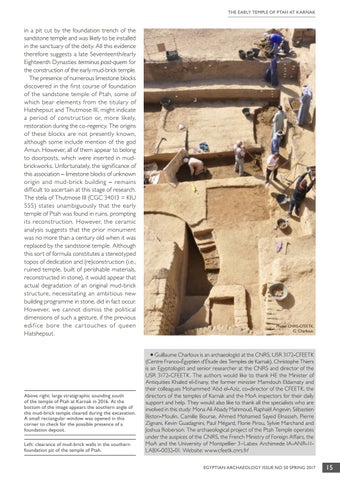
Above right: large stratigraphic sounding south of the temple of Ptah at Karnak in 2016. At the bottom of the image appears the southern angle of the mud-brick temple cleared during the excavation. A small rectangular window was opened in this corner to check for the possible presence of a foundation deposit. Left: clearance of mud-brick walls in the southern foundation pit of the temple of Ptah.
Photo: CNRS-CFEETK, G. Charloux.
• Guillaume Charloux is an archaeologist at the CNRS, USR 3172-CFEETK (Centre Franco-Égyptien d’Étude des Temples de Karnak). Christophe Thiers is an Egyptologist and senior researcher at the CNRS and director of the USR 3172-CFEETK. The authors would like to thank HE the Minister of Antiquities Khaled el-Enany, the former minister Mamdouh Eldamaty and their colleagues Mohammed ‘Abd el-Aziz, co-director of the CFEETK, the directors of the temples of Karnak and the MoA inspectors for their daily support and help. They would also like to thank all the specialists who are involved in this study: Mona Ali Abady Mahmoud, Raphaël Angevin, Sébastien Biston-Moulin, Camille Bourse, Ahmed Mohamed Sayed Elnasseh, Pierre Zignani, Kevin Guadagnini, Paul Mégard, Florie Pirou, Sylvie Marchand and Joshua Roberson. The archaeological project of the Ptah Temple operates under the auspices of the CNRS, the French Ministry of Foreign Affairs, the MoA and the University of Montpellier 3–Labex Archimede IA-ANR-11LABX-0032-01. Website: www.cfeetk.cnrs.fr/ EGYPTIAN ARCHAEOLOGY ISSUE NO 50 SPRING 2017
15