THE EARLY TEMPLE OF PTAH AT KARNAK
Plan: CNRS-CFEETK, G. Charloux, K. Guadagnini, P. Mégard, P. Zignani et al.
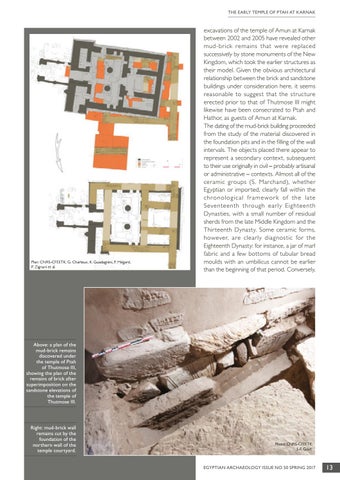
excavations of the temple of Amun at Karnak between 2002 and 2005 have revealed other mud-brick remains that were replaced successively by stone monuments of the New Kingdom, which took the earlier structures as their model. Given the obvious architectural relationship between the brick and sandstone buildings under consideration here, it seems reasonable to suggest that the structure erected prior to that of Thutmose III might likewise have been consecrated to Ptah and Hathor, as guests of Amun at Karnak. The dating of the mud-brick building proceeded from the study of the material discovered in the foundation pits and in the filling of the wall intervals. The objects placed there appear to represent a secondary context, subsequent to their use originally in civil – probably artisanal or administrative – contexts. Almost all of the ceramic groups (S. Marchand), whether Egyptian or imported, clearly fall within the chr onological fr amewor k of the late Seventeenth through early Eighteenth Dynasties, with a small number of residual sherds from the late Middle Kingdom and the Thirteenth Dynasty. Some ceramic forms, however, are clearly diagnostic for the Eighteenth Dynasty: for instance, a jar of marl fabric and a few bottoms of tubular bread moulds with an umbilicus cannot be earlier than the beginning of that period. Conversely,
Above: a plan of the mud-brick remains discovered under the temple of Ptah of Thutmose III, showing the plan of the remains of brick after superimposition on the sandstone elevations of the temple of Thutmose III.
Right: mud-brick wall remains cut by the foundation of the northern wall of the temple courtyard.
Photo: CNRS-CFEETK, J.-F. Gout.
EGYPTIAN ARCHAEOLOGY ISSUE NO 50 SPRING 2017
13