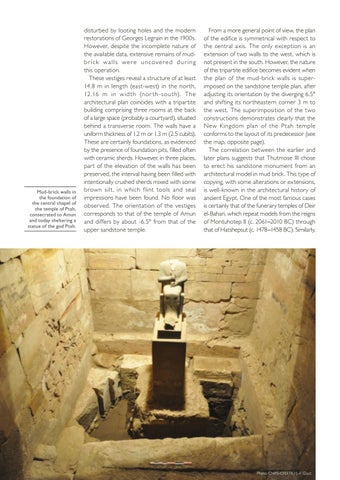
Mud-brick walls in the foundation of the central chapel of the temple of Ptah, consecrated to Amun and today sheltering a statue of the god Ptah.
12
disturbed by looting holes and the modern restorations of Georges Legrain in the 1900s. However, despite the incomplete nature of the available data, extensive remains of mudb r i c k w a l l s w e r e u n cov e r e d d u r i n g this operation. These vestiges reveal a structure of at least 14.8 m in length (east-west) in the nor th, 12.16 m in wid th (nor th-sou th). The architectural plan coincides with a tripartite building comprising three rooms at the back of a large space (probably a courtyard), situated behind a transverse room. The walls have a uniform thickness of 1.2 m or 1.3 m (2.5 cubits). These are certainly foundations, as evidenced by the presence of foundation pits, filled often with ceramic sherds. However, in three places, part of the elevation of the walls has been preserved, the interval having been filled with intentionally crushed sherds mixed with some brown silt, in which f lint tools and seal impressions have been found. No floor was observed. The orientation of the vestiges corresponds to that of the temple of Amun and differs by about -6.5° from that of the upper sandstone temple.
From a more general point of view, the plan of the edifice is symmetrical with respect to the central axis. The only exception is an extension of two walls to the west, which is not present in the south. However, the nature of this tripartite edifice becomes evident when the plan of the mud-brick walls is superimposed on the sandstone temple plan, after adjusting its orientation by the diverging 6.5° and shifting its northeastern corner 3 m to the west. The superimposition of the two constructions demonstrates clearly that the New Kingdom plan of the Ptah temple conforms to the layout of its predecessor (see the map, opposite page). The correlation between the earlier and later plans suggests that Thutmose III chose to erect his sandstone monument from an architectural model in mud brick. This type of copying, with some alterations or extensions, is well-known in the architectural history of ancient Egypt. One of the most famous cases is certainly that of the funerary temples of Deir el-Bahari, which repeat models from the reigns of Montuhotep II (c. 2061–2010 BC) through that of Hatshepsut (c. 1478–1458 BC). Similarly,
Photo: CNRS-CFEETK / J.-F. Gout.