Photo: CNRS-CFEETK / J.F. Gout
The early temple of Ptah at Karnak Recent excavations in the temple of Ptah at Karnak confirm the existence of an earlier mud-brick sanctuary. Guillaume Charloux and Christophe Thiers unveil the first elements of the discovery. The temple of Ptah, built by Thutmose III (1479–1425 BC, Eighteenth Dynasty), is located at the northern limit of the religious domain of Karnak (see Egyptian Archeology 38). The existence of an earlier temple – the date of which remains unknown – is recorded in two inscriptions of the present temple and on a stela erected by Thutmose III and restored later by Seti I (1290–1279 BC) (Catalogue général des antiquités égyptiennes du Musée du Caire, GC 34013): (…) My majesty found this temple built of mud brick, its columns and its doors in wood, which went to ruin. My majesty ordered to stretch the line for the temple again, edifying it in perfect white sandstone, the walls protecting it being made of bricks in durable work for eternity (…)
(transl. after S. Biston-Moulin)
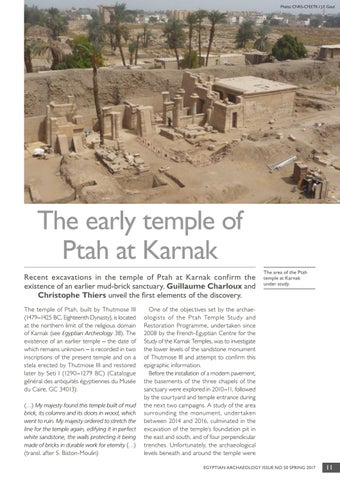
The area of the Ptah temple at Karnak under study.
One of the objectives set by the archaeologists of the P tah Temple Study and Restoration Programme, undertaken since 2008 by the French-Egyptian Centre for the Study of the Karnak Temples, was to investigate the lower levels of the sandstone monument of Thutmose III and attempt to confirm this epigraphic information. Before the installation of a modern pavement, the basements of the three chapels of the sanctuary were explored in 2010–11, followed by the courtyard and temple entrance during the next two campaigns. A study of the area surrounding the monument, under taken between 2014 and 2016, culminated in the excavation of the temple’s foundation pit in the east and south, and of four perpendicular trenches. Unfortunately, the archaeological levels beneath and around the temple were EGYPTIAN ARCHAEOLOGY ISSUE NO 50 SPRING 2017
11