Photo: Erin Peters
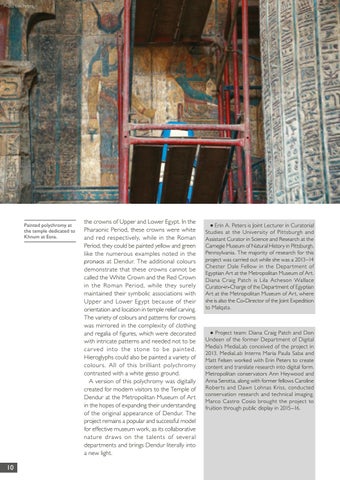
Painted polychromy at the temple dedicated to Khnum at Esna.
10
the crowns of Upper and Lower Egypt. In the Pharaonic Period, these crowns were white and red respectively, while in the Roman Period, they could be painted yellow and green like the numerous examples noted in the pronaos at Dendur. The additional colours demonstrate that these crowns cannot be called the White Crown and the Red Crown in the Roman Period, while they surely maintained their symbolic associations with Upper and Lower Egypt because of their orientation and location in temple relief carving. The variety of colours and patterns for crowns was mirrored in the complexity of clothing and regalia of figures, which were decorated with intricate patterns and needed not to be car ved into the s tone to be painted. Hieroglyphs could also be painted a variety of colours. All of this brilliant polychromy contrasted with a white gesso ground. A version of this polychromy was digitally created for modern visitors to the Temple of Dendur at the Metropolitan Museum of Art in the hopes of expanding their understanding of the original appearance of Dendur. The project remains a popular and successful model for effective museum work, as its collaborative nature draws on the talents of several departments and brings Dendur literally into a new light.
• Erin A. Peters is Joint Lecturer in Curatorial Studies at the University of Pittsburgh and Assistant Curator in Science and Research at the Carnegie Museum of Natural History in Pittsburgh, Pennsylvania. The majority of research for this project was carried out while she was a 2013–14 Chester Dale Fellow in the Depar tment of Egyptian Art at the Metropolitan Museum of Art. Diana Craig Patch is Lila Acheson Wallace Curator-in-Charge of the Department of Egyptian Art at the Metropolitan Museum of Art, where she is also the Co-Director of the Joint Expedition to Malqata. • Project team: Diana Craig Patch and Don Undeen of the former Department of Digital Media’s MediaLab conceived of the project in 2013. MediaLab Interns Maria Paula Saba and Matt Felsen worked with Erin Peters to create content and translate research into digital form. Metropolitan conservators Ann Heywood and Anna Serotta, along with former fellows Caroline Rober ts and Dawn Lohnas Kriss, conducted conservation research and technical imaging. Marco Castro Cosio brought the project to fruition through public display in 2015–16.