LIVING COLOUR: THE MET MUSEUM’S TEMPLE OF DENDUR
Photo: Erin Peters
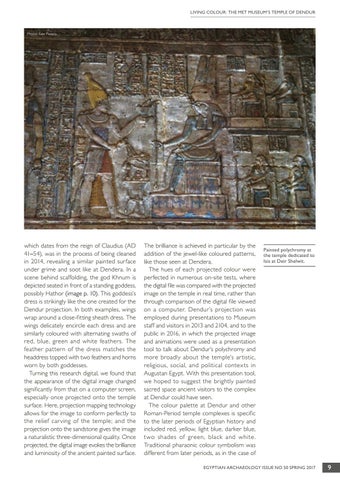
which dates from the reign of Claudius (AD 41–54), was in the process of being cleaned in 2014, revealing a similar painted surface under grime and soot like at Dendera. In a scene behind scaffolding, the god Khnum is depicted seated in front of a standing goddess, possibly Hathor (image p. 10). This goddess’s dress is strikingly like the one created for the Dendur projection. In both examples, wings wrap around a close-fitting sheath dress. The wings delicately encircle each dress and are similarly coloured with alternating swaths of red, blue, green and white feathers. The feather pattern of the dress matches the headdress topped with two feathers and horns worn by both goddesses. Turning this research digital, we found that the appearance of the digital image changed significantly from that on a computer screen, especially once projected onto the temple surface. Here, projection mapping technology allows for the image to conform perfectly to the relief carving of the temple; and the projection onto the sandstone gives the image a naturalistic three-dimensional quality. Once projected, the digital image evokes the brilliance and luminosity of the ancient painted surface.
The brilliance is achieved in particular by the addition of the jewel-like coloured patterns, like those seen at Dendera. The hues of each projected colour were perfected in numerous on-site tests, where the digital file was compared with the projected image on the temple in real time, rather than through comparison of the digital file viewed on a computer. Dendur’s projection was employed during presentations to Museum staff and visitors in 2013 and 2104, and to the public in 2016, in which the projected image and animations were used as a presentation tool to talk about Dendur’s polychromy and more broadly about the temple’s ar tistic, religious, social, and political contexts in Augustan Egypt. With this presentation tool, we hoped to suggest the brightly painted sacred space ancient visitors to the complex at Dendur could have seen. The colour palette at Dendur and other Roman-Period temple complexes is specific to the later periods of Egyptian history and included red, yellow, light blue, darker blue, two shades of green, black and white. Traditional pharaonic colour symbolism was different from later periods, as in the case of
Painted polychromy at the temple dedicated to Isis at Deir Shelwit.
EGYPTIAN ARCHAEOLOGY ISSUE NO 50 SPRING 2017
9