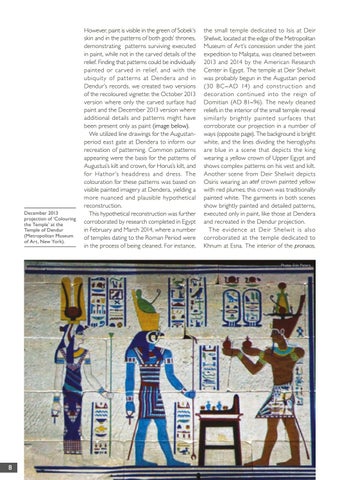
December 2013 projection of ‘Colouring the Temple’ at the Temple of Dendur (Metropolitan Museum of Art, New York).
However, paint is visible in the green of Sobek’s skin and in the patterns of both gods’ thrones, demonstrating patterns surviving executed in paint, while not in the carved details of the relief. Finding that patterns could be individually painted or carved in relief, and with the ubiquity of patterns at Dendera and in Dendur’s records, we created two versions of the recoloured vignette: the October 2013 version where only the carved surface had paint and the December 2013 version where additional details and patterns might have been present only as paint (image below). We utilized line drawings for the Augustanperiod east gate at Dendera to inform our recreation of patterning. Common patterns appearing were the basis for the patterns of Augustus’s kilt and crown, for Horus’s kilt, and for Hathor’s headdress and dress. The colouration for these patterns was based on visible painted imagery at Dendera, yielding a more nuanced and plausible hypothetical reconstruction. This hypothetical reconstruction was further corroborated by research completed in Egypt in February and March 2014, where a number of temples dating to the Roman Period were in the process of being cleaned. For instance,
the small temple dedicated to Isis at Deir Shelwit, located at the edge of the Metropolitan Museum of Art’s concession under the joint expedition to Malqata, was cleaned between 2013 and 2014 by the American Research Center in Egypt. The temple at Deir Shelwit was probably begun in the Augustan period (30 BC–AD 14) and construc tion and decoration continued into the reign of Domitian (AD 81–96). The newly cleaned reliefs in the interior of the small temple reveal similarly brightly painted sur faces that corroborate our projection in a number of ways (opposite page). The background is bright white, and the lines dividing the hieroglyphs are blue in a scene that depicts the king wearing a yellow crown of Upper Egypt and shows complex patterns on his vest and kilt. Another scene from Deir Shelwit depicts Osiris wearing an atef crown painted yellow with red plumes; this crown was traditionally painted white. The garments in both scenes show brightly painted and detailed patterns, executed only in paint, like those at Dendera and recreated in the Dendur projection. The evidence at Deir Shelwit is also corroborated at the temple dedicated to Khnum at Esna. The interior of the pronaos, Photo: Erin Peters
8