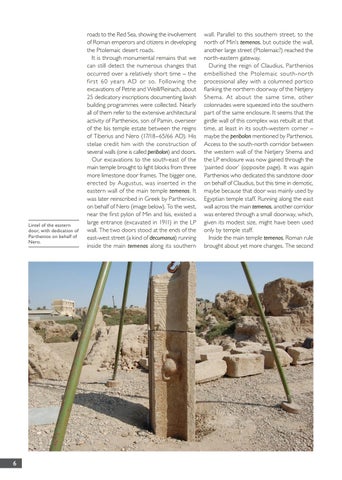
Lintel of the eastern door, with dedication of Parthenios on behalf of Nero.
6
roads to the Red Sea, showing the involvement of Roman emperors and citizens in developing the Ptolemaic desert roads. It is through monumental remains that we can still detect the numerous changes that occurred over a relatively short time – the f irst 60 years AD or so. Following the excavations of Petrie and Weill/Reinach, about 25 dedicatory inscriptions documenting lavish building programmes were collected. Nearly all of them refer to the extensive architectural activity of Parthenios, son of Pamin, overseer of the Isis temple estate between the reigns of Tiberius and Nero (17/18–65/66 AD). His stelae credit him with the construction of several walls (one is called peribolon) and doors. Our excavations to the south-east of the main temple brought to light blocks from three more limestone door frames. The bigger one, erected by Augustus, was inser ted in the eastern wall of the main temple temenos. It was later reinscribed in Greek by Parthenios, on behalf of Nero (image below). To the west, near the first pylon of Min and Isis, existed a large entrance (excavated in 1911) in the LP wall. The two doors stood at the ends of the east-west street (a kind of decumanus) running inside the main temenos along its southern
wall. Parallel to this southern street, to the north of Min’s temenos, but outside the wall, another large street (Ptolemaic?) reached the north-eastern gateway. During the reign of Claudius, Parthenios embellished the P tolemaic south-nor th processional alley with a columned portico flanking the northern doorway of the Netjery Shema. At about the same time, other colonnades were squeezed into the southern part of the same enclosure. It seems that the girdle wall of this complex was rebuilt at that time, at least in its south-western corner – maybe the peribolon mentioned by Parthenios. Access to the south-north corridor between the western wall of the Netjery Shema and the LP enclosure was now gained through the ‘painted door’ (opposite page). It was again Parthenios who dedicated this sandstone door on behalf of Claudius, but this time in demotic, maybe because that door was mainly used by Egyptian temple staff. Running along the east wall across the main temenos, another corridor was entered through a small doorway, which, given its modest size, might have been used only by temple staff. Inside the main temple temenos, Roman rule brought about yet more changes. The second