COPTOS: THE SACRED PRECINCTS IN PTOLEMAIC AND ROMAN TIMES
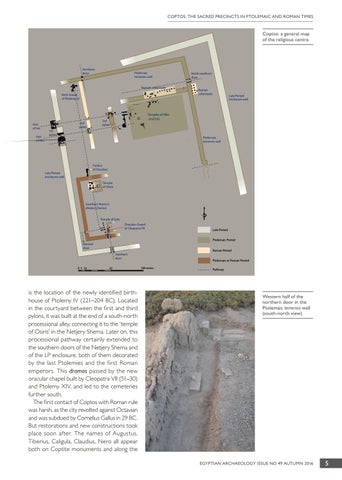
Coptos: a general map of the religious centre.
Northern door
Ptolemaic temenos wall Roman colonnade
Birth-house of Ptolemy IV
Axis of Isis Axis of Min
Roman colonnade
Late Period enclosure wall
Temple of Min and Isis
3rd pylon
2nd pylon
North-easthern door
1st pylon
Ptolemaic temenos wall
Portico of Claudius
Late Period enclosure wall
Temple of Osiris
Southern Precinct (Netjery Chema) N
Temple of Geb Oracular chapel of Cleopatra VII
Late Period Ptolemaic Period
Painted door
Roman Period
Southern door 0 5 10
50
is the location of the newly identified birthhouse of Ptolemy IV (221–204 BC). Located in the courtyard between the first and third pylons, it was built at the end of a south-north processional alley, connecting it to the ‘temple of Osiris’ in the Netjery Shema. Later on, this processional pathway certainly extended to the southern doors of the Netjery Shema and of the LP enclosure, both of them decorated by the last Ptolemies and the first Roman emperors. This dromos passed by the new oracular chapel built by Cleopatra VII (51–30) and Ptolemy XIV, and led to the cemeteries further south. The first contact of Coptos with Roman rule was harsh, as the city revolted against Octavian and was subdued by Cornelius Gallus in 29 BC. But restorations and new constructions took place soon after. The names of Augustus, Tiberius, Caligula, Claudius, Nero all appear both on Coptite monuments and along the
Ptolemaic or Roman Period 100 meters
Pathway
Western half of the northern door in the Ptolemaic temenos wall (south-north view).
EGYPTIAN ARCHAEOLOGY ISSUE NO 49 AUTUMN 2016
5