Coptos: the sacred precincts in Ptolemaic and Roman times In spite of the extensive excavations of Petrie (1893–94) and Reinach and Weill (1910–11) in Coptos, the layout of the temples area remains obscure. Laure Pantalacci and Cédric Gobeil, heading the joint IFAO/ Université de Lyon mission, present new data and current hypotheses about its configuration.
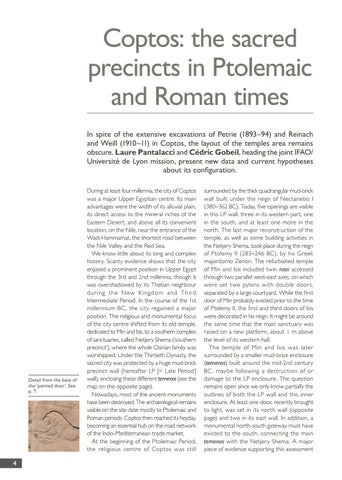
Detail from the base of the ‘painted door’. See p. 7.
4
During at least four millennia, the city of Coptos was a major Upper Egyptian centre. Its main advantages were the width of its alluvial plain, its direct access to the mineral riches of the Eastern Desert, and above all its convenient location, on the Nile, near the entrance of the Wadi Hammamat, the shortest road between the Nile Valley and the Red Sea. We know little about its long and complex history. Scanty evidence shows that the city enjoyed a prominent position in Upper Egypt through the 3rd and 2nd millennia, though it was overshadowed by its Theban neighbour dur ing the New K ingdom and T hir d Intermediate Period. In the course of the 1st millennium BC, the city regained a major position. The religious and monumental focus of the city centre shifted from its old temple, dedicated to Min and Isis, to a southern complex of sanctuaries, called Netjery Shema (‘southern precinct’), where the whole Osirian family was worshipped. Under the Thirtieth Dynasty, the sacred city was protected by a huge mud-brick precinct wall (hereafter LP [= Late Period] wall), enclosing these different temenoi (see the map on the opposite page). Nowadays, most of the ancient monuments have been destroyed. The archaeological remains visible on the site date mostly to Ptolemaic and Roman periods. Coptos then reached its heyday, becoming an essential hub on the road network of the Indo-Mediterranean trade market. At the beginning of the Ptolemaic Period, the religious centre of Coptos was still
surrounded by the thick quadrangular mud-brick wall built under the reign of Nectanebo I (380–362 BC). Today, five openings are visible in this LP wall: three in its western part, one in the south, and at least one more in the north. The last major reconstruction of the temple, as well as some building activities in the Netjery Shema, took place during the reign of Ptolemy II (283–246 BC), by his Greek majordomo Zenon. The refurbished temple of Min and Isis included twin naoi accessed through two parallel west-east axes, on which were set two pylons with double doors, separated by a large courtyard. While the first door of Min probably existed prior to the time of Ptolemy II, the first and third doors of Isis were decorated in his reign. It might be around the same time that the main sanctuary was raised on a new platform, about 1 m above the level of its western hall. The temple of Min and Isis was later surrounded by a smaller mud-brick enclosure (temenos) built around the mid-2nd century BC, maybe following a destruction of or damage to the LP enclosure. The question remains open since we only know partially the outlines of both the LP wall and this inner enclosure. At least one door, recently brought to light, was set in its north wall (opposite page) and two in its east wall. In addition, a monumental north-south gateway must have existed to the south, connecting the main temenos with the Netjery Shema. A major piece of evidence supporting this assessment