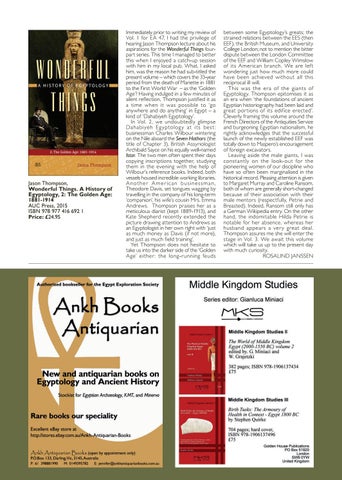
Jason Thompson, Wonderful Things. A History of Egyptology, 2: The Golden Age: 1881-1914 AUC Press, 2015 ISBN 978 977 416 692 1 Price: £24.95
48
Immediately prior to writing my review of Vol. 1 for EA 47, I had the privilege of hearing Jason Thompson lecture about his aspirations for the Wonderful Things fourpart series. This time I managed to better this when I enjoyed a catch-up session with him in my local pub. What, I asked him, was the reason he had sub-titled the present volume – which covers the 33-year period from the death of Mariette in 1881 to the First World War – as the ‘Golden Age’? Having indulged in a few minutes of silent reflection, Thompson justified it as a time when it was possible to ‘go anywhere and do anything’ in Egypt – a kind of ‘Dahabiyeh Egyptology’. In Vol. 2, we undoubtedly glimpse Dahabiyeh Eg yptolog y at its bes t: businessman Charles Wilbour wintering on the Nile aboard the Seven Hathors (the title of Chapter 3), British Assyriologist Archibald Sayce on his equally well-named Istar. The two men often spent their days copying inscriptions together, studying them in the evening with the help of Wilbour’s reference books. Indeed, both vessels housed incredible working libraries. A n ot h e r A m e r i c a n b u s i n e s s m a n , Theodore Davis, set tongues wagging by travelling in the company of his long-term ‘companion’, his wife’s cousin Mrs. Emma Andrews. Thompson praises her as a meticulous diarist (kept 1889-1913), and Kate Shepherd recently extended the picture drawing attention to Andrews as an Egyptologist in her own right with ‘just as much money as Davis (if not more), and just as much field training’. Yet Thompson does not hesitate to take us into the darker side of the ‘Golden Age’ either: the long-running feuds
between some Egyptology’s greats; the strained relations between the EES (then EEF), the British Museum, and University College London; not to mention the bitter dispute between the London Committee of the EEF and William Copley Wimslow of its American branch. We are left wondering just how much more could have been achieved without all this reciprocal ill will. This was the era of the giants of Egyptology. Thompson epitomises it as an era when ‘the foundations of ancient Egyptian historiography had been laid and great por tions of its edifice erected’. Cleverly framing this volume around the French Directors of the Antiquities Service and burgeoning Egyptian nationalism, he rightly acknowledges that the successful launch of the newly established EEF was totally down to Maspero’s encouragement of foreign excavators. Leaving aside the male giants, I was constantly on the look-out for the pioneering women of our discipline who have so often been marginalised in the historical record. Pleasing attention is given to Margaret Murray and Caroline Ransom, both of whom are generally short-changed because of their association with their male mentors (respectfully, Petrie and Breasted). Indeed, Ransom still only has a German Wikipedia entry. On the other hand, the indomitable Hilda Petrie is notable for her absence, whereas her husband appears a ver y great deal. Thompson assures me she will enter the stage in Vol. 3. We await this volume which will take us up to the present day with much curiosity. ROSALIND JANSSEN