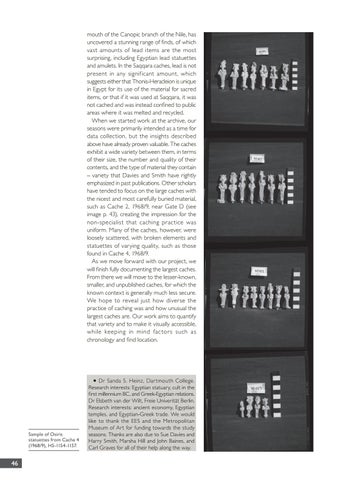
mouth of the Canopic branch of the Nile, has uncovered a stunning range of finds, of which vast amounts of lead items are the most surprising, including Egyptian lead statuettes and amulets. In the Saqqara caches, lead is not present in any significant amount, which suggests either that Thonis-Heracleion is unique in Egypt for its use of the material for sacred items, or that if it was used at Saqqara, it was not cached and was instead confined to public areas where it was melted and recycled. When we started work at the archive, our seasons were primarily intended as a time for data collection, but the insights described above have already proven valuable. The caches exhibit a wide variety between them, in terms of their size, the number and quality of their contents, and the type of material they contain – variety that Davies and Smith have rightly emphasized in past publications. Other scholars have tended to focus on the large caches with the nicest and most carefully buried material, such as Cache 2, 1968/9, near Gate D (see image p. 43), creating the impression for the non-specialist that caching practice was uniform. Many of the caches, however, were loosely scattered, with broken elements and statuettes of varying quality, such as those found in Cache 4, 1968/9. As we move forward with our project, we will finish fully documenting the largest caches. From there we will move to the lesser-known, smaller, and unpublished caches, for which the known context is generally much less secure. We hope to reveal just how diverse the practice of caching was and how unusual the largest caches are. Our work aims to quantify that variety and to make it visually accessible, while keeping in mind fac tor s such as chronology and find location.
Sample of Osiris statuettes from Cache 4 (1968/9), H5-1154-1157.
46
• Dr Sanda S. Heinz, Dar tmouth College. Research interests: Egyptian statuary, cult in the first millennium BC, and Greek-Egyptian relations. Dr Elsbeth van der Wilt, Freie Univerität Berlin. Research interests: ancient economy, Egyptian temples, and Egyptian-Greek trade. We would like to thank the EES and the Metropolitan Museum of Art for funding towards the study seasons. Thanks are also due to Sue Davies and Harry Smith, Marsha Hill and John Baines, and Carl Graves for all of their help along the way.