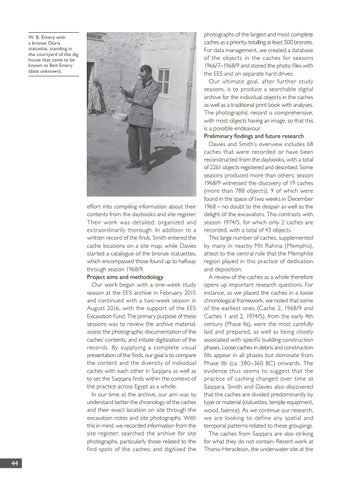
W. B. Emery with a bronze Osiris statuette, standing in the courtyard of the dig house that came to be known as Beit Emery (date unknown).
effort into compiling information about their contents from the daybooks and site register. Their work was detailed, organized and extraordinarily thorough. In addition to a written record of the finds, Smith entered the cache locations on a site map, while Davies started a catalogue of the bronze statuettes, which encompassed those found up to halfway through season 1968/9. Project aims and methodology Our work began with a one-week study season at the EES archive in February 2015 and continued with a two-week season in August 2016, with the support of the EES Excavation Fund. The primary purpose of these sessions was to review the archive material, assess the photographic documentation of the caches’ contents, and initiate digitization of the records. By supplying a complete visual presentation of the finds, our goal is to compare the content and the diversity of individual caches with each other in Saqqara as well as to set the Saqqara finds within the context of the practice across Egypt as a whole. In our time at the archive, our aim was to understand better the chronology of the caches and their exact location on site through the excavation notes and site photographs. With this in mind, we recorded information from the site register; searched the archive for site photographs, particularly those related to the find spots of the caches; and digitized the
44
photographs of the largest and most complete caches as a priority, totalling at least 500 bronzes. For data management, we created a database of the objects in the caches for seasons 1966/7–1968/9 and stored the photo files with the EES and on separate hard drives. Our ultimate goal, after fur ther study seasons, is to produce a searchable digital archive for the individual objects in the caches as well as a traditional print book with analyses. The photographic record is comprehensive, with most objects having an image, so that this is a possible endeavour. Preliminary findings and future research Davies and Smith’s overview includes 68 caches that were recorded or have been reconstructed from the daybooks, with a total of 2261 objects registered and described. Some seasons produced more than others: season 1968/9 witnessed the discovery of 19 caches (more than 788 objects), 9 of which were found in the space of two weeks in December 1968 – no doubt to the despair as well as the delight of the excavators. This contrasts with season 1974/5, for which only 2 caches are recorded, with a total of 43 objects. This large number of caches, supplemented by many in nearby Mit Rahina (Memphis), attest to the central role that the Memphite region played in this practice of dedication and deposition. A review of the caches as a whole therefore opens up important research questions. For instance, as we placed the caches in a loose chronological framework, we noted that some of the earliest ones (Cache 2, 1968/9 and Caches 1 and 2, 1974/5), from the early 4th century (Phase IIa), were the most carefully laid and prepared, as well as being closely associated with specific building construction phases. Loose caches in debris and construction fills appear in all phases but dominate from Phase IIb (ca. 380–360 BC) onwards. The evidence thus seems to suggest that the practice of caching changed over time at Saqqara. Smith and Davies also discovered that the caches are divided predominantly by type or material (statuettes, temple equipment, wood, faience). As we continue our research, we are looking to define any spatial and temporal patterns related to these groupings. The caches from Saqqara are also striking for what they do not contain. Recent work at Thonis-Heracleion, the underwater site at the