Buried bronzes: caches of the Sacred Animal Necropolis The caches of the North Saqqara Sacred Animal Necropolis are the last major group of unpublished material from the 1964–1976 EES mission. Since 2014, all documentation concerning the work and objects has been kept at the EES’ Lucy Gura Archive in London. As Sanda Heinz and Elsbeth van der Wilt argue, the quality of the material in the caches is often spectacular and deserves full treatment, although for practical reasons their project is currently based on excavation records. Here, they discuss the archive and their plans for publication of the caches. Caches in Saqqara Caching is the burial of sacred items after their removal from display. Saqqara is exceptional due to the number of caches discovered (68), the wealth of material preserved in them, and its detailed archaeological records. The caches were secondary deposits placed around the temple complex and catacombs. Most comprised bronze statuettes of deities and kings, and/or bronze ritual equipment. Other materials, such as wood, faience and stone, were found in lesser quantities. Significantly, these items were decommissioned and then buried, rather than being melted down, despite their economic value. The practice of offering bronze statuettes gained frequency in the Third Intermediate Period, flourished in the Late Period, and continued under the Ptolemies. The Sacred Animal Necropolis in North Saqqara (SAQSAN) was active for hundreds of years during this time, and the caches of statuettes perfectly illustrate this trend. Certain well-dated animal mummy burials provide a chronological framework for the site, from the Saite Twentysixth Dynasty through the Ptolemaic Period. The archive H. S. Smith and S. Davies returned the archive of the SAQ-SAN finds to the EES in 2014. It contains daybooks, object registers, photo documentation, drawings, museum
distribution lists, facsimiles of inscriptions, and co r r e s p o n d e n ce . I t a l s o co m p r i s e s documentation on the inscriptions, the D e m o t i c a n d A r a m a i c p a py r i , t h e i r transcriptions, and other material from research that is now published. Smith and Davies consider the caches the most important remaining category of finds to be published, and so they put considerable
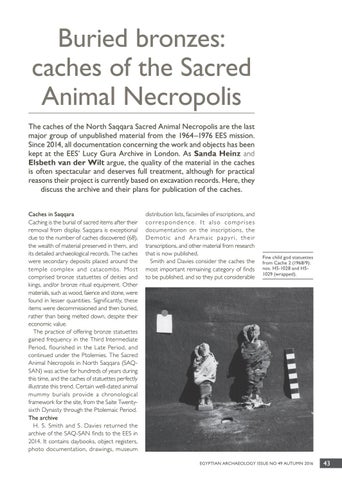
Fine child god statuettes from Cache 2 (1968/9): nos. H5-1028 and H51029 (wrapped).
EGYPTIAN ARCHAEOLOGY ISSUE NO 49 AUTUMN 2016
43