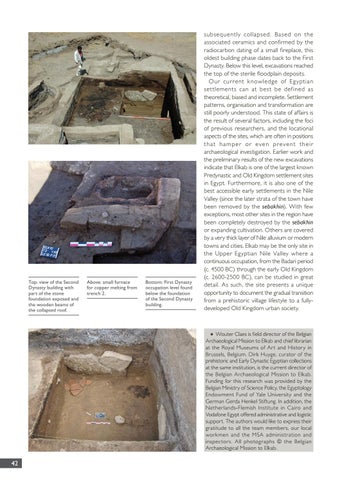
Top: view of the Second Dynasty building with part of the stone foundation exposed and the wooden beams of the collapsed roof.
Above: small furnace for copper melting from trench 2.
Bottom: First Dynasty occupation level found below the foundation of the Second Dynasty building.
subsequently collapsed. Based on the associated ceramics and confirmed by the radiocarbon dating of a small fireplace, this oldest building phase dates back to the First Dynasty. Below this level, excavations reached the top of the sterile floodplain deposits. Our cur rent k nowledge of Eg yptian set tlements can at best be def ined as theoretical, biased and incomplete. Settlement patterns, organisation and transformation are still poorly understood. This state of affairs is the result of several factors, including the foci of previous researchers, and the locational aspects of the sites, which are often in positions t h a t h a m p e r o r eve n p r eve n t t h e i r archaeological investigation. Earlier work and the preliminary results of the new excavations indicate that Elkab is one of the largest known Predynastic and Old Kingdom settlement sites in Egypt. Furthermore, it is also one of the best accessible early settlements in the Nile Valley (since the later strata of the town have been removed by the sebakhin). With few exceptions, most other sites in the region have been completely destroyed by the sebakhin or expanding cultivation. Others are covered by a very thick layer of Nile alluvium or modern towns and cities. Elkab may be the only site in the Upper Egyptian Nile Valley where a continuous occupation, from the Badari period (c. 4500 BC) through the early Old Kingdom (c. 2600-2500 BC), can be studied in great detail. As such, the site presents a unique opportunity to document the gradual transition from a prehistoric village lifestyle to a fullydeveloped Old Kingdom urban society.
• Wouter Claes is field director of the Belgian Archaeological Mission to Elkab and chief librarian at the Royal Museums of Ar t and History in Brussels, Belgium. Dirk Huyge, curator of the prehistoric and Early Dynastic Egyptian collections at the same institution, is the current director of the Belgian Archaeological Mission to Elkab. Funding for this research was provided by the Belgian Ministry of Science Policy, the Egyptology Endowment Fund of Yale University and the German Gerda Henkel Stiftung. In addition, the Netherlands-Flemish Institute in Cairo and Vodafone Egypt offered administrative and logistic support. The authors would like to express their gratitude to all the team members, our local workmen and the MSA administration and inspectors. All photographs Š the Belgian Archaeological Mission to Elkab. 42