FINDS FROM ELKAB: REVEALING THE ORIGINS OF THE SETTLEMENT
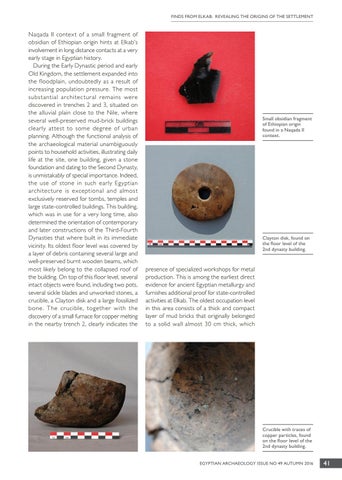
Naqada II context of a small fragment of obsidian of Ethiopian origin hints at Elkab’s involvement in long distance contacts at a very early stage in Egyptian history. During the Early Dynastic period and early Old Kingdom, the settlement expanded into the floodplain, undoubtedly as a result of increasing population pressure. The most substantial architec tural remains were discovered in trenches 2 and 3, situated on the alluvial plain close to the Nile, where several well-preserved mud-brick buildings clearly attest to some degree of urban planning. Although the functional analysis of the archaeological material unambiguously points to household activities, illustrating daily life at the site, one building, given a stone foundation and dating to the Second Dynasty, is unmistakably of special importance. Indeed, the use of stone in such early Egyptian architecture is exceptional and almost exclusively reserved for tombs, temples and large state-controlled buildings. This building, which was in use for a very long time, also determined the orientation of contemporary and later constructions of the Third-Fourth Dynasties that where built in its immediate vicinity. Its oldest floor level was covered by a layer of debris containing several large and well-preserved burnt wooden beams, which most likely belong to the collapsed roof of the building. On top of this floor level, several intact objects were found, including two pots, several sickle blades and unworked stones, a crucible, a Clayton disk and a large fossilized bone. The crucible, together with the discovery of a small furnace for copper melting in the nearby trench 2, clearly indicates the
Small obsidian fragment of Ethiopian origin found in a Naqada II context.
Clayton disk, found on the floor level of the 2nd dynasty building.
presence of specialized workshops for metal production. This is among the earliest direct evidence for ancient Egyptian metallurgy and furnishes additional proof for state-controlled activities at Elkab. The oldest occupation level in this area consists of a thick and compact layer of mud bricks that originally belonged to a solid wall almost 30 cm thick, which
Crucible with traces of copper particles, found on the floor level of the 2nd dynasty building. EGYPTIAN ARCHAEOLOGY ISSUE NO 49 AUTUMN 2016
41