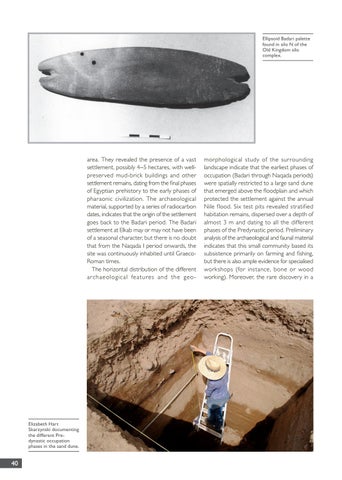
Ellipsoid Badari palette found in silo N of the Old Kingdom silo complex.
area. They revealed the presence of a vast settlement, possibly 4–5 hectares, with wellpreserved mud-brick buildings and other settlement remains, dating from the final phases of Egyptian prehistory to the early phases of pharaonic civilization. The archaeological material, supported by a series of radiocarbon dates, indicates that the origin of the settlement goes back to the Badari period. The Badari settlement at Elkab may or may not have been of a seasonal character, but there is no doubt that from the Naqada I period onwards, the site was continuously inhabited until GraecoRoman times. The horizontal distribution of the different archaeological featur es and the geo -
Elizabeth Hart Skarzynski documenting the different Predynastic occupation phases in the sand dune.
40
morphological study of the surrounding landscape indicate that the earliest phases of occupation (Badari through Naqada periods) were spatially restricted to a large sand dune that emerged above the floodplain and which protected the settlement against the annual Nile flood. Six test pits revealed stratified habitation remains, dispersed over a depth of almost 3 m and dating to all the different phases of the Predynastic period. Preliminary analysis of the archaeological and faunal material indicates that this small community based its subsistence primarily on farming and fishing, but there is also ample evidence for specialised workshops (for instance, bone or wood working). Moreover, the rare discovery in a