FINDS FROM ELKAB: REVEALING THE ORIGINS OF THE SETTLEMENT
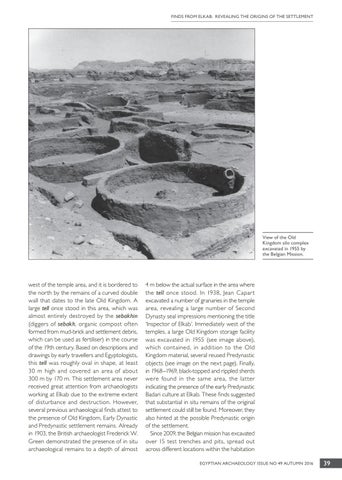
View of the Old Kingdom silo complex excavated in 1955 by the Belgian Mission.
west of the temple area, and it is bordered to the north by the remains of a curved double wall that dates to the late Old Kingdom. A large tell once stood in this area, which was almost entirely destroyed by the sebakhin (diggers of sebakh, organic compost often formed from mud-brick and settlement debris, which can be used as fertiliser) in the course of the 19th century. Based on descriptions and drawings by early travellers and Egyptologists, this tell was roughly oval in shape, at least 30 m high and covered an area of about 300 m by 170 m. This settlement area never received great attention from archaeologists working at Elkab due to the extreme extent of disturbance and destruction. However, several previous archaeological finds attest to the presence of Old Kingdom, Early Dynastic and Predynastic settlement remains. Already in 1903, the British archaeologist Frederick W. Green demonstrated the presence of in situ archaeological remains to a depth of almost
4 m below the actual surface in the area where the tell once stood. In 1938, Jean Capar t excavated a number of granaries in the temple area, revealing a large number of Second Dynasty seal impressions mentioning the title ‘Inspector of Elkab’. Immediately west of the temples, a large Old Kingdom storage facility was excavated in 1955 (see image above), which contained, in addition to the Old Kingdom material, several reused Predynastic objects (see image on the next page). Finally, in 1968–1969, black-topped and rippled sherds were found in the same area, the latter indicating the presence of the early Predynastic Badari culture at Elkab. These finds suggested that substantial in situ remains of the original settlement could still be found. Moreover, they also hinted at the possible Predynastic origin of the settlement. Since 2009, the Belgian mission has excavated over 15 test trenches and pits, spread out across different locations within the habitation EGYPTIAN ARCHAEOLOGY ISSUE NO 49 AUTUMN 2016
39