consisting of a unusual kind of cartonnage made of mud. The preserved portions of it still showed traces of decoration. Wrapped around the body of the N skeleton, we found a net of beads in faïence of different colours, still arranged according to the original weave. www.cefb.it, www.facebook. com/C.E.Francesco.Ballerini
Thebes (Dra Abu el-Naga): The CSIC
excavation continued at the S-W of the open courtyard of TT 11. Three 17th/early 18th Dyn shafts were dug. At the bottom of one of them were found fragmentary inscriptions bearing the name of prince Intefmose, as well as cartouches of Montuhotep Nebhepetra, Senwosret I and Sobekemsaf. A second shaft, carefully hewn and of larger dimensions, was reused by six individuals in the 22nd Dyn. A stela of this period and faience fragments with cartouches of Osorkon II were found elsewhere. Near another shaft, the mummy of a ram was found on the ground in a 13th-17th Dyn context. Moreover, analysis continued of the animal mummies and bones (mostly of ibis and falcons) that were deposited in the burial chambers of the funerary shaft of Hery (TT 12) and of the neighbouring tomb-chapel (-399-) in the 2nd century BC. Epigraphy and restoration of the inner walls of both Djehuty and Hery’s tomb-chapels (TT 11-12) is in progress. www.excavacionegipto.com
(Elephantine): The joint DAI/Swiss Inst team directed by Stephan Seidlmayer, Felix Arnold, Johanna Sigl and Cornelius von Pilgrim continued fieldwork on Elephantine Island in three seasons between Oct 2015 and May 2016. In the N-W town of Elephantine excavations for the achaeometric project ‘Realities of Life’ revealed remains of two houses, built at the beginning of the MK, their use continuing through the whole period. Miniscule splinters
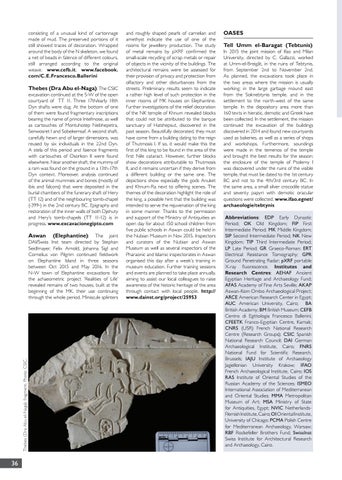
Thebes (Dra Abu el-Naga): fragment. Photo: CSIC.
Aswan
36
and roughly shaped pearls of carnelian and amethyst indicate the use of one of the rooms for jewellery production. The study of metal remains by pXRF confirmed the small-scale recycling of scrap metals or repair of objects in the vicinity of the buildings. The architectural remains were be assessed for their provision of privacy and protection from olfactory and other disturbances from the streets. Preliminary results seem to indicate a rather high level of such protection in the inner rooms of MK houses on Elephantine. Further investigations of the relief decoration of the NK temple of Khnum revealed blocks that could not be attributed to the barque sanctuary of Hatshepsut, discovered in the past season. Beautifully decorated, they must have come from a building dating to the reign of Thutmosis I. If so, it would make this the first of this king to be found in the area of the first Nile cataract. However, further blocks show decorations attributable to Thutmosis II, and it remains uncertain if they derive from a different building or the same one. The depictions show especially the gods Anuket and Khnum-Ra next to offering scenes. The themes of the decoration highlight the role of the king, a possible hint that the building was intended to serve the rejuvenation of the king in some manner. Thanks to the permission and support of the Ministry of Antiquities an open day for about 150 school children from five public schools in Aswan could be held in the Nubian Museum in Nov 2015. Inspectors and curators of the Nubian and Aswan Museum as well as several inspectors of the Pharaonic and Islamic inspectorates in Aswan organised this day after a week’s training in museum education. Further training sessions and events are planned to take place annually, aiming to assist our local colleagues to raise awareness of the historic heritage of the area through contact with local people. http:// www.dainst.org/project/25953
OASES Tell Umm el-Baragat (Tebtunis): In 2015 the joint mission of Ifao and Milan University, directed by C. Gallazzi, worked at Umm-el-Breigât, in the ruins of Tebtynis, from September 2nd to November 2nd. As planned, the excavations took place in the two areas where the mission is usually working: in the large garbage mound east from the Soknebtynis temple, and in the settlement to the north-west of the same temple. In the depository area more than 160 texts in hieratic, demotic and Greek have been collected. In the settlement, the mission continued the excavation of the buildings discovered in 2014 and found new courtyards used as bakeries, as well as a series of shops and workshops. Furthermore, soundings were made in the temenos of the temple and brought the best results for the season: the enclosure of the temple of Ptolemy I was discovered under the ruins of the visible temple, that must be dated to the 1st century BC and not to the 4th/3rd century BC. In the same area, a small silver crocodile statue and seventy papyri with demotic oracular questions were collected. www.ifao.egnet/ archaeologie/tebtynis Abbreviations: EDP Early Dynastic Period; OK Old Kingdom; FIP First Intermediate Period; MK Middle Kingdom; SIP Second Intermediate Period; NK New Kingdom; TIP Third Intermediate Period; LP Late Period; GR Graeco-Roman; ERT Electrical Resistance Tomography; GPR Ground Penetrating Radar; pXRF portable X-ray fluorescence. Institutes and Research Centres: AEHAF Ancient Egyptian Heritage and Archaeology Fund; AFAS Academy of Fine Arts Seville; AKAP Aswan-Kom Ombo Archaeological Project; ARCE American Research Center in Egypt; AUC American University, Cairo; BA British Academy; BM British Museum; CEFB Centro di Egittologia Francesco Ballerini; CFEETK Franco-Egyptian Centre, Karnak; CNRS (USR) French National Research Centre (Research Groups); CSIC Spanish National Research Council; DAI German Archaeological Institute, Cairo; FNRS National Fund for Scientific Research, Brussels; IAJU Institute of Archaeology Jagiellonian University Krakow; IFAO French Archaeological Institute, Cairo; IOS RAS Institute of Oriental Studies of the Russian Academy of the Sciences; ISMEO International Association of Mediterranean and Oriental Studies; MMA Metropolitan Museum of Art; MSA Ministry of State for Antiquities, Egypt; NVIC NetherlandsFlemish Institute, Cairo; OI Oriental Institute, University of Chicago; PCMA Polish Centre for Mediterranean Archaeology, Warsaw; RBF Rockefeller Brothers Fund; SwissInst Swiss Institute for Architectural Research and Archaeology, Cairo.