DIGGING DIARY 2016
UPPER EGYPT Athribis: The Athribis Project of the
University of Tübingen and the MSA, led by Christian Leitz and directed in the field by Marcus Müller, continued its work in the Repit temple of Ptolemy XII. In the 14th season (Dec. 2015 – March 2016) three rooms were excavated, one with important new inscriptions with well-preserved colours, two were without texts or scenes. The excavation of the northern ambulatory was finished, so that the unique rear entrance is fully visible. Near the north-western corner of the temple two more columns appeared. The secondary blocking of the door to the western court also revealed important inscribed blocks. A newly discovered, uninscribed crypt consists of one room with a niche and had no finds inside. All rooms contained finds of daily life dating post 642 A.D. when the temple was used for domestic purposes, dumping ground, and as animal shelter. Epigraphic work focused on collationating many texts in various rooms and the recording of newly discovered texts. Consolidation and restoration was undertaken at numerous spots throughout the temple, on collapsed blocks, and single
finds, mainly on polychrome reliefs. Next to the temple the re-erection of a Hathor capital was finished (photo), and the rearrangement of architraves of the pronaos was continued. http://www.athribis.unituebingen.de/
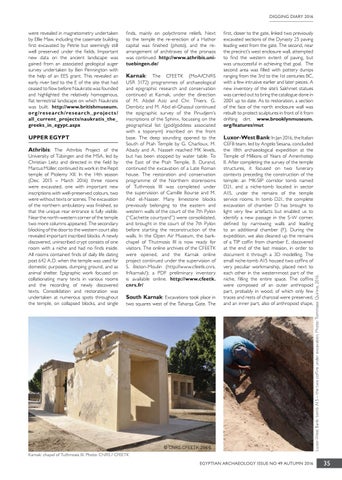
Karnak : The CFEETK (MoA/CNRS USR 3172) programmes of archaeological and epigraphic research and conservation continued at Karnak, under the direction of M. Abdel Aziz and Chr. Thiers. G. Dembitz and M. Abd el-Ghassul continued the epigraphic survey of the Pinudjem’s inscriptions of the Sphinx, focussing on the geographical list (god/goddess associated with a toponym) inscribed on the front base. The deep sounding opened to the South of Ptah Temple by G. Charloux, M. Abady and A. Nasseh reached MK levels, but has been stopped by water table. To the East of the Ptah Temple, B. Durand, continued the excavation of a Late Roman house. The restoration and conservation programme of the Northern storerooms of Tuthmosis III was completed under the supervision of Camille Bourse and M. Abd el-Nasser. Many limestone blocks previously belonging to the eastern and western walls of the court of the 7th Pylon (“Cachette courtyard”) were consolidated, and brought in the court of the 7th Pylon before starting the reconstruction of the walls. In the Open Air Museum, the barkchapel of Thutmosis III is now ready for visitors. The online archives of the CFEETK were opened, and the Karnak online project continued under the supervision of S. Biston-Moulin (http://www.cfeetk.cnrs. fr/karnak/); a PDF preliminary inventory is available online. http://www.cfeetk. cnrs.fr/ South Karnak: Excavations took place in two squares west of the Taharqa Gate. The
first, closer to the gate, linked two previously excavated sections of the Dynasty 25 paving leading west from the gate. The second, near the precinct’s west enclosure wall, attempted to find the western extent of paving, but was unsuccessful in achieving that goal. The second area was filled with pottery dumps ranging from the 3rd to the 1st centuries BC, with a few intrusive earlier and later pieces. A new inventory of the site’s Sakhmet statues was carried out to bring the catalogue done in 2001 up to date. As to restoration, a section of the face of the north enclosure wall was rebuilt to protect sculptures in front of it from drifting dirt. www.brooklynmuseum. org/features/mut
Luxor-West Bank : In Jan 2016, the Italian CEFB team, led by Angelo Sesana, concluded the 18th archaeological expedition at the Temple of Millions of Years of Amenhotep II. After completing the survey of the temple structures, it focused on two funerary contexts preceding the construction of the temple: an MK-SIP corridor tomb named D21, and a niche-tomb located in sector A15, under the remains of the temple service rooms. In tomb D21, the complete excavation of chamber D has brought to light very few artefacts but enabled us to identify a new passage in the S-W corner, defined by narrowing walls and leading to an additional chamber (F). During the expedition, we also cleaned up the remains of a TIP coffin from chamber E, discovered at the end of the last mission, in order to document it through a 3D modelling. The small niche-tomb A15 housed two coffins of very peculiar workmanship, placed next to each other in the westernmost part of the niche, filling the entire space. The coffins were composed of an outer anthropoid part, probably in wood, of which only few traces and rests of charcoal were preserved, and an inner part, also of anthropoid shape,
Luxor-West Bank: tomb A15 – the two coffins under excavation. Photo: Tommaso Quirino, 2016.
were revealed in magnetometry undertaken by Ellie Maw, including the casemate building first excavated by Petrie but seemingly still well preserved under the fields. Important new data on the ancient landscape was gained from an associated geological auger survey undertaken by Ben Pennington with the help of an EES grant. This revealed an early river bed to the E of the site that had ceased to flow before Naukratis was founded and highlighted the relatively homogenous, flat terrestrial landscape on which Naukratis was built. http://www.britishmuseum. org /re s e a rc h /re s e a rc h _ projec t s / all_current_projects/naukratis_the_ greeks_in_egypt.aspx
Karnak: chapel of Tuthmosis III. Photo: CNRS / CFEETK EGYPTIAN ARCHAEOLOGY ISSUE NO 49 AUTUMN 2016
35