THE EARLY RAMESSIDE OCCUPANTS OF TOMB MIDAN.05
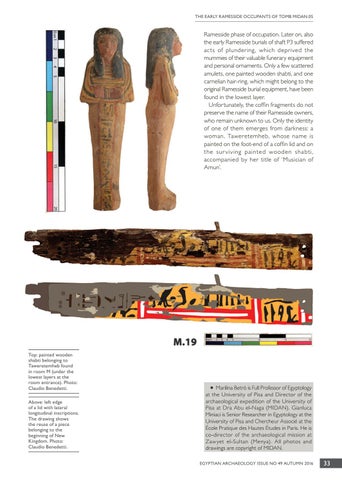
Ramesside phase of occupation. Later on, also the early Ramesside burials of shaft P3 suffered acts of plundering, which deprived the mummies of their valuable funerary equipment and personal ornaments. Only a few scattered amulets, one painted wooden shabti, and one carnelian hair-ring, which might belong to the original Ramesside burial equipment, have been found in the lowest layer. Unfortunately, the coffin fragments do not preserve the name of their Ramesside owners, who remain unknown to us. Only the identity of one of them emerges from darkness: a woman, Taweretemheb, whose name is painted on the foot-end of a coffin lid and on the sur viving painted wooden shabti, accompanied by her title of ‘Musician of Amun’.
Top: painted wooden shabti belonging to Taweretemheb found in room M (under the lowest layers at the room entrance). Photo: Claudio Benedetti. Above: left edge of a lid with lateral longitudinal inscriptions. The drawing shows the reuse of a piece belonging to the beginning of New Kingdom. Photo: Claudio Benedetti.
• Marilina Betrò is Full Professor of Egyptology at the University of Pisa and Director of the archaeological expedition of the University of Pisa at Dra Abu el-Naga (MIDAN). Gianluca Miniaci is Senior Researcher in Egyptology at the University of Pisa and Chercheur Associé at the École Pratique des Hautes Études in Paris. He is co-director of the archaeological mission at Zawyet el-Sultan (Menya). All photos and drawings are copyright of MIDAN. EGYPTIAN ARCHAEOLOGY ISSUE NO 49 AUTUMN 2016
33