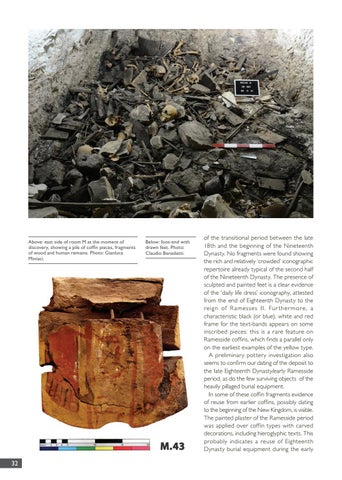
Above: east side of room M at the moment of discovery, showing a pile of coffin pieces, fragments of wood and human remains. Photo: Gianluca Miniaci.
32
Below: foot-end with drawn feet. Photo: Claudio Benedetti.
of the transitional period between the late 18th and the beginning of the Nineteenth Dynasty. No fragments were found showing the rich and relatively ‘crowded’ iconographic repertoire already typical of the second half of the Nineteenth Dynasty. The presence of sculpted and painted feet is a clear evidence of the ‘daily life dress’ iconography, attested from the end of Eighteenth Dynasty to the reign of R amesses II . Fur ther more, a characteristic black (or blue), white and red frame for the text-bands appears on some inscribed pieces: this is a rare feature on Ramesside coffins, which finds a parallel only on the earliest examples of the yellow type. A preliminary pottery investigation also seems to confirm our dating of the deposit to the late Eighteenth Dynasty/early Ramesside period, as do the few surviving objects of the heavily pillaged burial equipment. In some of these coffin fragments evidence of reuse from earlier coffins, possibly dating to the beginning of the New Kingdom, is visible. The painted plaster of the Ramesside period was applied over coffin types with carved decorations, including hieroglyphic texts. This probably indicates a reuse of Eighteenth Dynasty burial equipment during the early