THE EARLY RAMESSIDE OCCUPANTS OF TOMB MIDAN.05
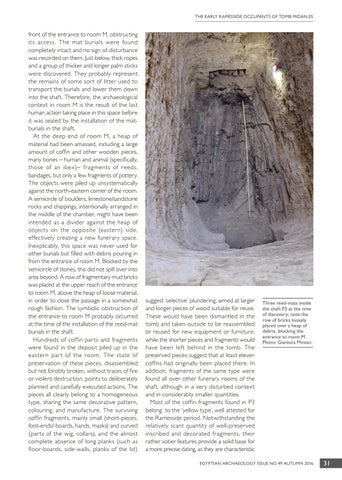
front of the entrance to room M, obstructing its access. The mat burials were found completely intact and no sign of disturbance was recorded on them. Just below, thick ropes and a group of thicker and longer palm sticks were discovered. They probably represent the remains of some sort of litter used to transport the burials and lower them down into the shaft. Therefore, the archaeological context in room M is the result of the last human action taking place in this space before it was sealed by the installation of the matburials in the shaft. At the deep end of room M, a heap of material had been amassed, including a large amount of coffin and other wooden pieces, many bones – human and animal (specifically, those of an ibex)– fragments of reeds, bandages, but only a few fragments of pottery. The objects were piled up unsystematically against the north-eastern corner of the room. A semicircle of boulders, limestone/sandstone rocks and chippings, intentionally arranged in the middle of the chamber, might have been intended as a divider against the heap of objects on the opposite (eastern) side, effectively creating a new funerary space. Inexplicably, this space was never used for other burials but filled with debris pouring in from the entrance of room M. Blocked by the semicircle of stones, this did not spill over into area beyond. A row of fragmentary mud bricks was placed at the upper reach of the entrance to room M, above the heap of loose material, in order to close the passage in a somewhat rough fashion. The symbolic obstruction of the entrance to room M probably occurred at the time of the installation of the reed-mat burials in the shaft. Hundreds of coffin par ts and fragments were found in the deposit piled up in the eastern par t of the room. The state of preservation of these pieces, disassembled but not forcibly broken, without traces of fire or violent destruction, points to deliberately planned and carefully executed actions. The pieces all clearly belong to a homogeneous type, sharing the same decorative pattern, colouring, and manufacture. The surviving coffin fragments, mainly small (short-pieces, foot-ends/-boards, hands, masks) and curved (par ts of the wig, collars), and the almost complete absence of long planks (such as floor-boards, side-walls, planks of the lid)
suggest ‘selective’ plundering, aimed at larger and longer pieces of wood suitable for reuse. These would have been dismantled in the tomb and taken outside to be reassembled or reused for new equipment or furniture, while the shorter pieces and fragments would have been left behind in the tomb. The preserved pieces suggest that at least eleven coffins had originally been placed there. In addition, fragments of the same type were found all over other funerary rooms of the shaft, although in a very disturbed context and in considerably smaller quantities. Most of the coffin fragments found in P3 belong to the ‘yellow type’, well attested for the Ramesside period. Notwithstanding the relatively scant quantity of well-preserved inscribed and decorated fragments, their rather sober features provide a solid base for a more precise dating, as they are characteristic
Three reed-mats inside the shaft P3 at the time of discovery; note the row of bricks loosely placed over a heap of debris, blocking the entrance to room M. Photo: Gianluca Miniaci.
EGYPTIAN ARCHAEOLOGY ISSUE NO 49 AUTUMN 2016
31