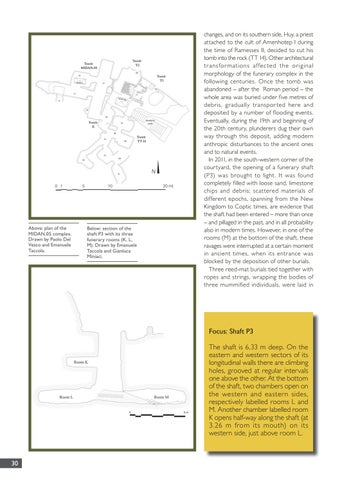
Above: plan of the MIDAN.05 complex. Drawn by Paolo Del Vesco and Emanuele Taccola.
Below: section of the shaft P3 with its three funerary rooms (K, L, M). Drawn by Emanuele Taccola and Gianluca Miniaci.
changes, and on its southern side, Huy, a priest attached to the cult of Amenhotep I during the time of Ramesses II, decided to cut his tomb into the rock (TT 14). Other architectural tr ansfor mations af fec ted the or iginal morphology of the funerary complex in the following centuries. Once the tomb was abandoned – after the Roman period – the whole area was buried under five metres of debris, gradually transpor ted here and deposited by a number of flooding events. Eventually, during the 19th and beginning of the 20th century, plunderers dug their own way through this deposit, adding modern anthropic disturbances to the ancient ones and to natural events. In 2011, in the south-western corner of the courtyard, the opening of a funerary shaft (P3) was brought to light. It was found completely filled with loose sand, limestone chips and debris; scattered materials of different epochs, spanning from the New Kingdom to Coptic times, are evidence that the shaft had been entered – more than once – and pillaged in the past, and in all probability also in modern times. However, in one of the rooms (M) at the bottom of the shaft, these ravages were interrupted at a certain moment in ancient times, when its entrance was blocked by the deposition of other burials. Three reed-mat burials tied together with ropes and strings, wrapping the bodies of three mummified individuals, were laid in
Focus: Shaft P3 The shaft is 6.33 m deep. On the eastern and western sectors of its longitudinal walls there are climbing holes, grooved at regular intervals one above the other. At the bottom of the shaft, two chambers open on the western and eastern sides, respectively labelled rooms L and M. Another chamber labelled room K opens half-way along the shaft (at 3.26 m from its mouth) on its western side, just above room L.
30