The early Ramesside occupants of tomb MIDAN.05 Marilina Betrò and Gianluca Miniaci continue the exploration of tomb MIDAN.05 in the Theban Necropolis. Discovered in 2004 by the archaeological expedition of the University of Pisa at Dra Abu el-Naga (= MIDAN: Missione archeologica Italiana a Dra Abu el-Naga) and under investigation since 2005, it turned out to be the largest and oldest among a cluster of rock-cut tombs, laid out around its forecourt. With the exception of TT 14, all of them had been unknown and unrecorded until then. Explorations at Dra Abu-el Naga since the early 19th century have brought to light a number of royal as well as non-royal burials dating from the Second Intermediate Period into the Saite Period. MIDAN.05 is located on the main hill of this area, just below the recently re-discovered pyramid of Nubkheperre Intef, one of the kings of the Seventeenth Dynasty. As our work shows, MIDAN.05 was used, re-used and occupied until the Graeco-Roman period. Its first phase, however, is datable to the very beginning of the New Kingdom, as attested by the presence of several rishi coffin
fragments (funerary coffins adorned with a feather design, t ypical of the Second Intermediate Period), found inside its burial rooms. A prolonged use of the structure, until the mid-Eighteenth Dynasty, is indicated by the surviving painted scenes on the walls, which can be stylistically dated no later than Thutmosis IV. However, the traces of the original occupants of this period are very scant, and at the moment the identity of the original owner or owners of the tomb is still unknown. In the Ramesside Period, the forecour t underwent some structural and functional
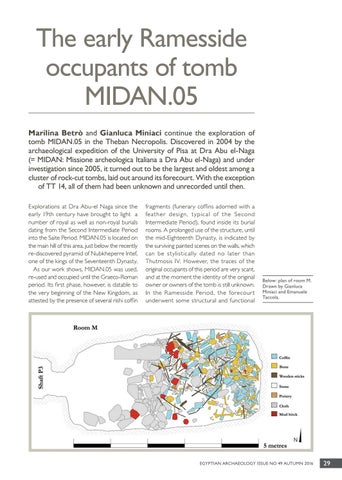
Below: plan of room M. Drawn by Gianluca Miniaci and Emanuele Taccola.
EGYPTIAN ARCHAEOLOGY ISSUE NO 49 AUTUMN 2016
29